| Voir le sujet précédent :: Voir le sujet suivant |
| Auteur |
Message |
kds315* 


Inscrit le: 12 Mar 2008
Messages: 16909
Localisation: Kehl, Germany
Expire: 2021-03-09
|
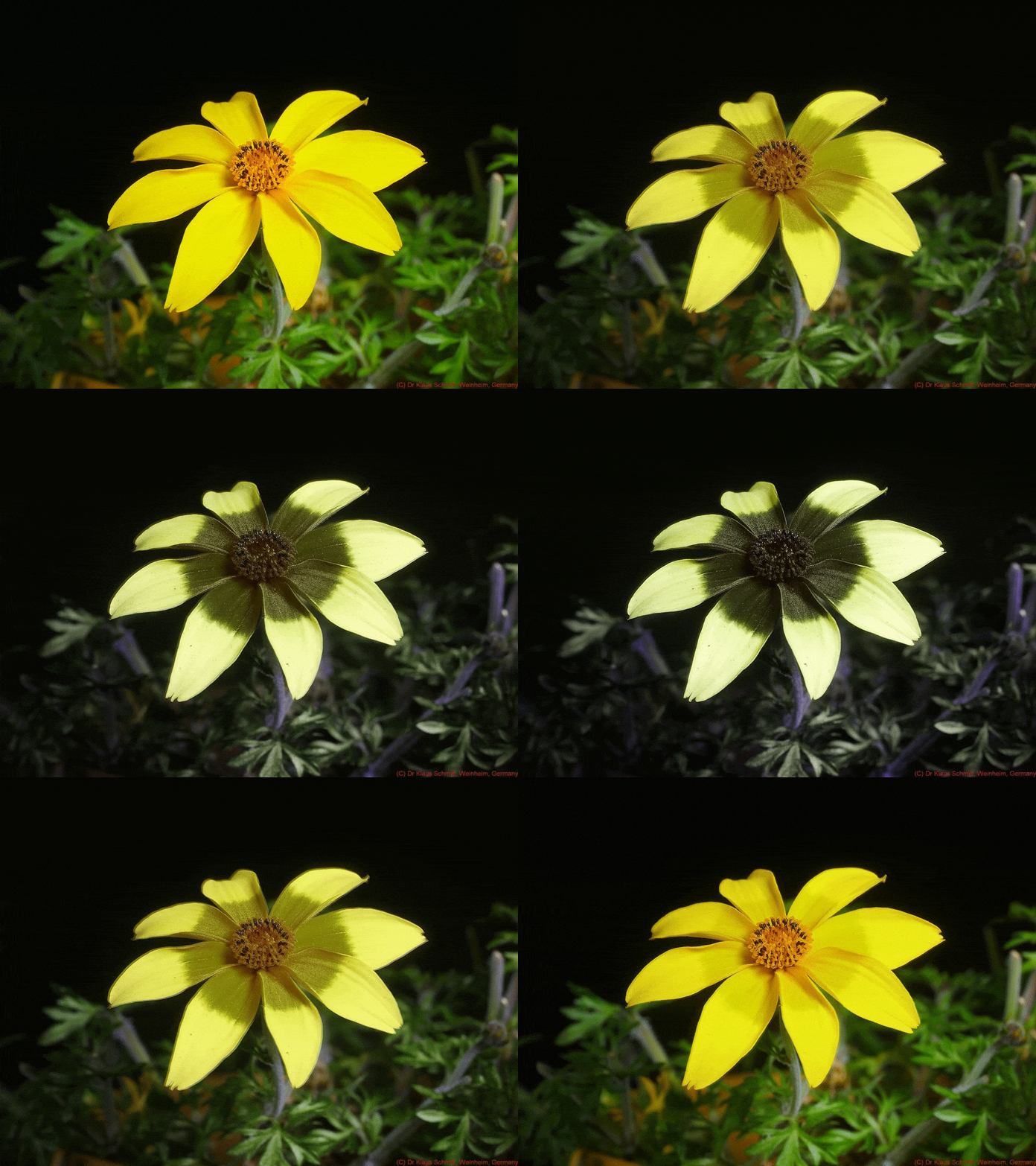
 Posté: Ven Juin 04, 2021 9:16 am Sujet du message: UV Nikkor 105mm does Bidens in VIS-UV |
|
Posté: Ven Juin 04, 2021 9:16 am Sujet du message: UV Nikkor 105mm does Bidens in VIS-UV |
|
|
kds315* wrote:
Amazing that dark "bullseye" UV-pattern bees and butterflies can see as a landing platform, but we humans cannot...
Shot using a UV-Nikkor 105mm at f11 on a full-specrum modified Panansonic GH4 using a modified studio flash.
There have been scientific experiments done (Prof. em. Klaus Lunau, Düsseldorf, Germany) which prove that bees
land on a flower petal and then always crawl to find the UV-dark part to find nectar and pollen (they artifically reversed
the petals and the bees then crawled to the outside and not to the center anymore)!
_________________
Klaus - Admin
"S'il vient a point, me souviendra" [Thomas Bohier (1460-1523)]
http://www.macrolenses.de for macro and special lens info
http://www.pbase.com/kds315/uv_photos for UV Images and lens/filter info
https://www.flickr.com/photos/kds315/albums my albums using various lenses
http://photographyoftheinvisibleworld.blogspot.com/ my UV BLOG
http://www.travelmeetsfood.com/blog Food + Travel BLOG
https://galeriafotografia.com Architecture + Drone photography
Currently most FAV lens(es):
X80QF f3.2/80mm
Hypergon f11/26mm
ELCAN UV f5.6/52mm
Zeiss UV-Planar f4/60mm
Zeiss UV-Planar f2/62mm
Lomo Уфар-12 f2.5/41mm
Lomo Зуфар-2 f4.0/350mm
Lomo ZIKAR-1A f1.2/100mm
Nikon UV Nikkor f4.5/105mm
Zeiss UV-Sonnar f4.3/105mm
CERCO UV-VIS-NIR f1.8/45mm
CERCO UV-VIS-NIR f4.1/94mm
CERCO UV-VIS-NIR f2.8/100mm
Steinheil Quarzobjektiv f1.8/50mm
Pentax Quartz Takumar f3.5/85mm
Carl Zeiss Jena UV-Objektiv f4/60mm
NYE OPTICAL Lyman-Alpha II f1.1/90mm
NYE OPTICAL Lyman-Alpha I f2.8/200mm
COASTAL OPTICS f4/60mm UV-VIS-IR Apo
COASTAL OPTICS f4.5/105mm UV-Micro-Apo
Pentax Ultra-Achromatic Takumar f4.5/85mm
Pentax Ultra-Achromatic Takumar f5.6/300mm
Rodenstock UV-Rodagon f5.6/60mm + 105mm + 150mm
Dernière modification par kds315* le Lun Juin 07, 2021 4:33 pm ; modifié 1 fois au total |
|
| Haut de page |
|
 |
stevemark
Inscrit le: 29 Avr 2011
Messages: 5509
Localisation: Switzerland
|
Posté: Ven Juin 04, 2021 9:23 am Sujet du message: Re: UV NIkkor 105mm does Bidens in VIS-UV |
|
Posté: Ven Juin 04, 2021 9:23 am Sujet du message: Re: UV NIkkor 105mm does Bidens in VIS-UV |
|
|
stevemark wrote:
| kds315* a écrit: |
Amazing that dark "bullseye" UV-pattern bees and butterflies can see as a landing platform, but we humans cannot...
There have been scientific experiments done (Prof. em. Klaus Lunau, Düsseldorf, Germany) which prove that bees
land on a flower petal and then always crawl to find the UV-dark part to find nectar and pollen (they artifically reversed
the petals and the bees then crawled to the outside and not to the center anymore)!
|
Thanks for sharing this information! Having studied chemistry and then worked in the field of mass spectrometry and ion traps I'm not so familiar with biology  - but from a chemical standpoint I always wonder how a few very simple (??) atoms transform themselves into whatever we are seeing and experiencing. Truely a world of wonders!!
S
_________________
www.artaphot.ch |
|
| Haut de page |
|
|
visualopsins

Inscrit le: 05 Mar 2009
Messages: 11697
Localisation: California
Expire: 2027-07-11
|
Posté: Ven Juin 04, 2021 10:03 am Sujet du message: |
|
Posté: Ven Juin 04, 2021 10:03 am Sujet du message: |
|
|
visualopsins wrote:
 Oooooh, I like the new presentation Dr. !
@S, wonder no more after study of the visual opsins! https://en.m.wikipedia.org/wiki/Opsin (and http://visualopsins.weebly.com/about.html )
_________________
☮☮☮☮☮☮☮☮☮☮☮☮☮☮☮☮☮☮☮☮☮☮☮☮☮☮☮☮☮☮☮☮ like attracts like! ☮☮☮☮☮☮☮☮☮☮☮☮☮☮☮☮☮☮☮☮☮☮☮☮☮☮☮☮☮☮☮☮
Cameras: Sony ILCE-7RM2, Spotmatics II, F, and ESII, Nikon P4
Lenses:
M42 Asahi Optical Co., Takumar 1:4 f=35mm, 1:2 f=58mm (Sonnar), 1:2.4 f=58mm (Heliar), 1:2.2 f=55mm (Gaussian), 1:2.8 f=105mm (Model I), 1:2.8/105 (Model II), 1:5.6/200, Tele-Takumar 1:5.6/200, 1:6.3/300, Macro-Takumar 1:4/50, Auto-Takumar 1:2.3 f=35, 1:1.8 f=55mm, 1:2.2 f=55mm, Super-TAKUMAR 1:3.5/28 (fat), 1:2/35 (Fat), 1:1.4/50 (8-element), Super-Multi-Coated Fisheye-TAKUMAR 1:4/17, Super-Multi-Coated TAKUMAR 1:4.5/20, 1:3.5/24, 1:3.5/28, 1:2/35, 1:3.5/35, 1:1.8/85, 1:1.9/85 1:2.8/105, 1:3.5/135, 1:2.5/135 (II), 1:4/150, 1:4/200, 1:4/300, 1:4.5/500, Super-Multi-Coated Macro-TAKUMAR 1:4/50, 1:4/100, Super-Multi-Coated Bellows-TAKUMAR 1:4/100, SMC TAKUMAR 1:1.4/50, 1:1.8/55
M42 Carl Zeiss Jena Flektogon 2.4/35
Contax Carl Zeiss Vario-Sonnar T* 28-70mm F3.5-4.5
Pentax K-mount SMC PENTAX-A ZOOM 1:3.5 35~105mm, SMC PENTAX ZOOM 1:4 45~125mm
Nikon Micro-NIKKOR-P-C Auto 1:3.5 f=55mm, NIKKOR-P Auto 105mm f/2.5 Pre-AI (Sonnar), Micro-NIKKOR 105mm 1:4 AI, NIKKOR AI-S 35-135mm f/3,5-4,5
Solinon 1:5.6/18 ASPH.
Tamron SP 17mm f/3.5 (51B), Tamron SP 17mm f/3.5 (151B), SP 500mm f/8 (55BB), SP 70-210mm f/3.5 (19AH)
Vivitar 100mm 1:2.8 MC 1:1 Macro Telephoto (Kiron)
|
|
| Haut de page |
|
|
stevemark
Inscrit le: 29 Avr 2011
Messages: 5509
Localisation: Switzerland
|
Posté: Ven Juin 04, 2021 1:35 pm Sujet du message: |
|
Posté: Ven Juin 04, 2021 1:35 pm Sujet du message: |
|
|
stevemark wrote:
| visualopsins a écrit: |
@S, wonder no more after study of the visual opsins! |
Quite the contrary !! - I wonder even much more.
Nothing in the physical structure of the C atom (or the N or the H atom) suggests how on earth from those simple electron / proton / neutron "clouds" such magnificent and meaningful structures, objects and functions spontaneously can (and will) arise.
I (and probability calculations!) would expect chaos, not beauty and order
S
_________________
www.artaphot.ch |
|
| Haut de page |
|
|
visualopsins
Inscrit le: 05 Mar 2009
Messages: 11697
Localisation: California
Expire: 2027-07-11
|
Posté: Ven Juin 04, 2021 2:07 pm Sujet du message: |
|
Posté: Ven Juin 04, 2021 2:07 pm Sujet du message: |
|
|
visualopsins wrote:
| stevemark a écrit: |
| visualopsins a écrit: |
@S, wonder no more after study of the visual opsins! |
Quite the contrary !! - I wonder even much more.
Nothing in the physical structure of the C atom (or the N or the H atom) suggests how on earth from those simple electron / proton / neutron "clouds" such magnificent and meaningful structures, objects and functions spontaneously can (and will) arise.
I (and probability calculations!) would expect chaos, not beauty and order
S |
Spin & twist "vibration"...but yes indeed most remains mysterious.
| Citation: |
| Rhodopsin (Rh) and bathorhodopsin (bathoRh) quantum-mechanics/molecular-mechanics models based on ab initio multiconfigurational wave functions are employed to look at the light induced pi-bond breaking and reconstitution occurring during the Rh -> bathoRh and bathoRh -> Rh isomerizations. More specifically, semiclassical trajectory computations are used to compare the excited (S1) and ground (S0) state dynamics characterizing the opposite steps of the Rh/bathoRh photochromic cycle during the first 200 fs following photoexcitation. We show that the information contained in these data provide an unprecedented insight into the sub-picosecond pi-bond reconstitution process which is at the basis of the reactivity of the protein embedded 11-cis and all-trans retinal chromophores. More specifically, the data point to the phase and amplitude of the skeletal bond length alternation stretching mode as the key factor switching the chromophore to a bonding state. It is also confirmed/found that the phase and amplitude of the hydrogen-out-of-plane mode controls the stereochemical outcome of the forward and reverse photoisomerizations. |
https://scholarworks.bgsu.edu/cgi/viewcontent.cgi?article=1164&context=chem_pub
Apologies to Dr. Schmitt for diversion from topic.
_________________
☮☮☮☮☮☮☮☮☮☮☮☮☮☮☮☮☮☮☮☮☮☮☮☮☮☮☮☮☮☮☮☮ like attracts like! ☮☮☮☮☮☮☮☮☮☮☮☮☮☮☮☮☮☮☮☮☮☮☮☮☮☮☮☮☮☮☮☮
Cameras: Sony ILCE-7RM2, Spotmatics II, F, and ESII, Nikon P4
Lenses:
M42 Asahi Optical Co., Takumar 1:4 f=35mm, 1:2 f=58mm (Sonnar), 1:2.4 f=58mm (Heliar), 1:2.2 f=55mm (Gaussian), 1:2.8 f=105mm (Model I), 1:2.8/105 (Model II), 1:5.6/200, Tele-Takumar 1:5.6/200, 1:6.3/300, Macro-Takumar 1:4/50, Auto-Takumar 1:2.3 f=35, 1:1.8 f=55mm, 1:2.2 f=55mm, Super-TAKUMAR 1:3.5/28 (fat), 1:2/35 (Fat), 1:1.4/50 (8-element), Super-Multi-Coated Fisheye-TAKUMAR 1:4/17, Super-Multi-Coated TAKUMAR 1:4.5/20, 1:3.5/24, 1:3.5/28, 1:2/35, 1:3.5/35, 1:1.8/85, 1:1.9/85 1:2.8/105, 1:3.5/135, 1:2.5/135 (II), 1:4/150, 1:4/200, 1:4/300, 1:4.5/500, Super-Multi-Coated Macro-TAKUMAR 1:4/50, 1:4/100, Super-Multi-Coated Bellows-TAKUMAR 1:4/100, SMC TAKUMAR 1:1.4/50, 1:1.8/55
M42 Carl Zeiss Jena Flektogon 2.4/35
Contax Carl Zeiss Vario-Sonnar T* 28-70mm F3.5-4.5
Pentax K-mount SMC PENTAX-A ZOOM 1:3.5 35~105mm, SMC PENTAX ZOOM 1:4 45~125mm
Nikon Micro-NIKKOR-P-C Auto 1:3.5 f=55mm, NIKKOR-P Auto 105mm f/2.5 Pre-AI (Sonnar), Micro-NIKKOR 105mm 1:4 AI, NIKKOR AI-S 35-135mm f/3,5-4,5
Solinon 1:5.6/18 ASPH.
Tamron SP 17mm f/3.5 (51B), Tamron SP 17mm f/3.5 (151B), SP 500mm f/8 (55BB), SP 70-210mm f/3.5 (19AH)
Vivitar 100mm 1:2.8 MC 1:1 Macro Telephoto (Kiron)
|
|
| Haut de page |
|
|
KEO


Inscrit le: 27 Sep 2018
Messages: 813
Localisation: USA
|
Posté: Ven Juin 04, 2021 8:54 pm Sujet du message: Re: UV NIkkor 105mm does Bidens in VIS-UV |
|
Posté: Ven Juin 04, 2021 8:54 pm Sujet du message: Re: UV NIkkor 105mm does Bidens in VIS-UV |
|
|
KEO wrote:
| kds315* a écrit: |
| Amazing that dark "bullseye" UV-pattern bees and butterflies can see as a landing platform, but we humans cannot... |
I can remember shooting flowers (including Bidens) with auto white balance and ending up with completely messed up colors. I concluded there was light reflecting off the petals at wavelengths imperceptible to the human eye, but detectable by the camera, which caused the camera to adjust white balance incorrectly. Manually adjusting white balance fixed the problem.
It's worth remembering that your camera can "see" wavelengths of light beyond what your eye can perceive. |
|
| Haut de page |
|
|
kds315*
Inscrit le: 12 Mar 2008
Messages: 16909
Localisation: Kehl, Germany
Expire: 2021-03-09
|
Posté: Lun Juin 07, 2021 6:41 am Sujet du message: |
|
Posté: Lun Juin 07, 2021 6:41 am Sujet du message: |
|
|
kds315* wrote:
Thanks guys, glad you like it!
_________________
Klaus - Admin
"S'il vient a point, me souviendra" [Thomas Bohier (1460-1523)]
http://www.macrolenses.de for macro and special lens info
http://www.pbase.com/kds315/uv_photos for UV Images and lens/filter info
https://www.flickr.com/photos/kds315/albums my albums using various lenses
http://photographyoftheinvisibleworld.blogspot.com/ my UV BLOG
http://www.travelmeetsfood.com/blog Food + Travel BLOG
https://galeriafotografia.com Architecture + Drone photography
Currently most FAV lens(es):
X80QF f3.2/80mm
Hypergon f11/26mm
ELCAN UV f5.6/52mm
Zeiss UV-Planar f4/60mm
Zeiss UV-Planar f2/62mm
Lomo Уфар-12 f2.5/41mm
Lomo Зуфар-2 f4.0/350mm
Lomo ZIKAR-1A f1.2/100mm
Nikon UV Nikkor f4.5/105mm
Zeiss UV-Sonnar f4.3/105mm
CERCO UV-VIS-NIR f1.8/45mm
CERCO UV-VIS-NIR f4.1/94mm
CERCO UV-VIS-NIR f2.8/100mm
Steinheil Quarzobjektiv f1.8/50mm
Pentax Quartz Takumar f3.5/85mm
Carl Zeiss Jena UV-Objektiv f4/60mm
NYE OPTICAL Lyman-Alpha II f1.1/90mm
NYE OPTICAL Lyman-Alpha I f2.8/200mm
COASTAL OPTICS f4/60mm UV-VIS-IR Apo
COASTAL OPTICS f4.5/105mm UV-Micro-Apo
Pentax Ultra-Achromatic Takumar f4.5/85mm
Pentax Ultra-Achromatic Takumar f5.6/300mm
Rodenstock UV-Rodagon f5.6/60mm + 105mm + 150mm
|
|
| Haut de page |
|
|
JMC

Inscrit le: 29 Mai 2018
Messages: 185
Localisation: London, UK
|
Posté: Lun Juin 07, 2021 7:51 am Sujet du message: |
|
Posté: Lun Juin 07, 2021 7:51 am Sujet du message: |
|
|
JMC wrote:
Very nice Klaus  |
|
| Haut de page |
|
|
lumens pixel
Inscrit le: 27 Fév 2019
Messages: 1128
Expire: 2021-06-25
|
Posté: Lun Juin 07, 2021 8:42 am Sujet du message: |
|
Posté: Lun Juin 07, 2021 8:42 am Sujet du message: |
|
|
lumens pixel wrote:
Very interesting.
_________________
Lumens Pixel
-------------
Minolta SR mount: 16 2,8; Sigma SuperWide 24 2,8; 28 2,5; 28 2,8; 28 3,5; 35 2,8; 45 2,0; 50 1,4; 50 1,7; 50 2,0; 58 1,4; 85 2,0; 100 2,5; 100 4 Macro; 135 3,5; 135 2,8; 200 4; RF 250 5,6; 24-35 3,5; 35-70 3,5; 75-150 4; 70-210 4
Canon FD mount: Tokina RMC 17 3,5; 28 2,8; 35 2,8; 50 1,8; 50 3,5 Macro; 55 1,2; 135 3,5; 135 2,5; 200 4,0; 300 5,6; 28-55 3,5 4,5; Tokina SZ-X SD 270; 70-150 4,5; 70-210 f4; 80-200 4L; Tokina SZ-X 845
Tamron Adaptall: 28-80 3,5-4,2 (27A); 70-210 3,8-4 (46A); 60-300 (23A); 90 2,5 (52B); 35-135 3,5-4,5 (40A)
Tamron SP: 20-40 2,7-3,5 (266D) |
|
| Haut de page |
|
|
|
|
|
Vous ne pouvez pas publier de nouveaux sujets dans ce forum
Vous ne pouvez pas répondre aux sujets de ce forum
Vous ne pouvez pas modifier vos messages dans ce forum
Vous ne pouvez pas supprimer vos messages dans ce forum
Vous ne pouvez pas voter dans les sondages de ce forum
|
 Français
 Español
 中文
 Magyar
 Русский
 Deutsch
 日本語


