| Voir le sujet précédent :: Voir le sujet suivant |
| Auteur |
Message |
16:9 

Inscrit le: 04 Avr 2014
Messages: 319
Localisation: UK
|
 Posté: Sam Juil 01, 2023 12:16 pm Sujet du message: Isco v Schneider Projector Lenses: Cinelux, UltraStar, etc |
|
Posté: Sam Juil 01, 2023 12:16 pm Sujet du message: Isco v Schneider Projector Lenses: Cinelux, UltraStar, etc |
|
|
16:9 wrote:
I'm working on an updated guide to half a century of these great projector lenses, from their Kollmorgen roots to their succession by digitally-optimised lenses, complete with a previously unavailable serial number guide. Would the community be interested in helping out?
They're becoming quite collectable, so perhaps a few members (like me) have acquired a little collection.
Also, if you're in the UK, there's a need to compare directly samples of competing models, and tease apart (and show) differences in resolution and rendering. You may have found frustrating the scattering of often conflicting anecdotal information about which is better and why. Part of the problem is establishing which models were the same, which were different, when they changed, and how. The 2018 Boutique Lens article on is largely based on information published on the old Isco and Schneider websites, but by collecting other material and having a clearer timeline based on serials, and with input from sources closer to the companies, it's been possible to enlarge and correct it.
Three things would be really useful:
1. If you're able to post your serial numbers here, I can further refine the timeline. It's also a handy security register!
2. If you have period catalogues, brochures, adverts, reviews, articles or datasheets, please let me know.
3. If you're willing to meet up for testing – or loan, or exchange with me, some of your lenses, we can show comparisons that will be properly revealing.
Included in the remit would be AV-Cinelux, AV-Xenotar and Isco projector lenses (not the unserialled triplets).
_________________
If it ain't broke, break it. |
|
| Haut de page |
|
 |
jamaeolus


Inscrit le: 19 Mar 2014
Messages: 3202
Localisation: Eugene
Expire: 2015-08-20
|
Posté: Sam Juil 01, 2023 3:31 pm Sujet du message: |
|
Posté: Sam Juil 01, 2023 3:31 pm Sujet du message: |
|
|
jamaeolus wrote:
Sounds like good project.
_________________
photos are moments frozen in time |
|
| Haut de page |
|
|
eggplant


Inscrit le: 27 Mai 2020
Messages: 517
|
Posté: Sam Juil 01, 2023 5:07 pm Sujet du message: |
|
Posté: Sam Juil 01, 2023 5:07 pm Sujet du message: |
|
|
eggplant wrote:
N/A
_________________
UK
Dernière modification par eggplant le Dim Juil 09, 2023 7:00 pm ; modifié 4 fois au total |
|
| Haut de page |
|
|
16:9
Inscrit le: 04 Avr 2014
Messages: 319
Localisation: UK
|
Posté: Sam Juil 01, 2023 10:42 pm Sujet du message: |
|
Posté: Sam Juil 01, 2023 10:42 pm Sujet du message: |
|
|
16:9 wrote:
Thanks for making a great start. Collating this widely scattered information is enormously helpful. I'll give some thought to building an indexed section of Delta that allows source material out of copyright to be accessed.
As to testing these lenses with adequate centering, it's impossible to test a bunch of old lenses and provide an entirely defensible view of their finer-grained merits when new. I offer a ranking system on Delta that relies on repetition, trial and error to offer a guide I believe is helpful as a hierarchy of 'sharpness' – but I'm well aware that every aspect of this process, and almost everything in the preceding sentence, deserves (and isn't going to get) a(nother) lengthy discussion.
Not only would an empirically 100% assessment be unfeasible, it's unnecessary. What is much easier - and I think more relevant to today's use-case – is to demonstrate how these lenses draw. I don't believe anyone seriously expects (or demands) reference-grade resolution from using an adapted cine-projector lens. We have excellent modern primes for that. Right out of the gate, I'm willing to promise that at close distance, every such lens is a failure compared to current optics. Even at middle distance, in their comfort zone, the best of them only reach the level of a contemporary zoom lens in the middle of the frame, and not even that in the outer image circle.
I suggest the role of these lenses presently, and for the foreseeable future, is to deliver specific, characterful 'looks' without being consumed by aberrations. The bar isn't terribly high with regard to resolution. What would be more helpful in that regard is to publish the datasheets that would allow us to compare the MTF, complemented by controlled examples highlighting differences in bokeh, colour rendition, chromatic aberration, geometric distortion, field curvature, etc. The more we test, the more accurate the picture of their resolving capability will become.
_________________
If it ain't broke, break it. |
|
| Haut de page |
|
|
eggplant
Inscrit le: 27 Mai 2020
Messages: 517
|
Posté: Sam Juil 01, 2023 11:03 pm Sujet du message: |
|
Posté: Sam Juil 01, 2023 11:03 pm Sujet du message: |
|
|
eggplant wrote:
Fair enough, sorry if you thought I was prompting you to defend yourself on the back foot there, as I see your reasoning/have understood stuff you've said before.
_________________
UK |
|
| Haut de page |
|
|
16:9
Inscrit le: 04 Avr 2014
Messages: 319
Localisation: UK
|
Posté: Sam Juil 01, 2023 11:48 pm Sujet du message: |
|
Posté: Sam Juil 01, 2023 11:48 pm Sujet du message: |
|
|
16:9 wrote:
In which case - no, I'm sorry for being defensive!
Later models seem to resolve better than earlier ones, but are they as lush? That's evidently why people want them.
It's taken time to clarify the timeline an build a serial chart, but it's still unclear how equivalent Isco and Schneider offerings compare in terms of sharpness (less relevant in this case, I think), or other metrics. For example, it would be helpful to shoot a 75mm Isco-Optic UltraStar HD Plus against the directly comparable Super-Cinelux of c.2000.
Another useful comparison would be the 75mm Schneider Cine-Xenon vs Isco-Optic Ultra MC of c.1985. The Schneider is almost certainly superior technically, but how does its rendering differ? And how much worse is the Isco in practice? Is the Isco uniformly worse, or just a bit softer in the corners? Does it reach the standard of 'good enough'? One 'feature' of the shorter Ultra MC models that are surprisingly sharp in Zone A is profound tangential aberration, vignetting and abruptly tapering resolution in the outer image circle. Although this is a handicap for many compositions, if you require 3D isolation of a centrally-framed subject, it's a superpower – 'speedboosting' an f2.0 capture to look like it was shot at f1.4.
The story of Isco v Schneider derives from the chronology: the upgrades came from techniques and technologies available to both companies at similar times, and there was evidently some reactionary competition between them driving progress. The design goals were better resolution, lower aberration, and brighter, more even illumination. But today, we're more interested in whether those upgrades tangentially resulted in smoother bokeh and focus transition, or a different type of mechanical vignetting and 'swirl'.
The older lenses may have qualities a majority of viewers find more attractive and are similarly competent. Maybe we can locate and define a distinct UltraStar or Cinelux 'look' that persists over time. Or perhaps all the 1990s lenses shared common traits designed out of the later models. It's difficult to use this type of lens creatively without proper comprehension of their character and capability.
_________________
If it ain't broke, break it. |
|
| Haut de page |
|
|
simple.joy

Inscrit le: 30 Mai 2022
Messages: 954
|
Posté: Dim Juil 02, 2023 11:11 am Sujet du message: Re: Isco v Schneider Projector Lenses: Cinelux, UltraStar, e |
|
Posté: Dim Juil 02, 2023 11:11 am Sujet du message: Re: Isco v Schneider Projector Lenses: Cinelux, UltraStar, e |
|
|
simple.joy wrote:
Excellent information - thanks a lot for sharing that!
| 16:9 a écrit: |
I'm working on an updated guide to half a century of these great projector lenses, from their Kollmorgen roots to their succession by digitally-optimised lenses, complete with a previously unavailable serial number guide. Would the community be interested in helping out?
1. If you're able to post your serial numbers here, I can further refine the timeline. It's also a handy security register!
Included in the remit would be AV-Cinelux, AV-Xenotar and Isco projector lenses (not the unserialled triplets). |
Here are the relevant ones I have, including serial number if they have one.
Isco-Optic Ultra Star-HD 65/2 (765488)
Isco-Optic Ultra-Star HD Plus 75/2.1 (475134)
Schneider-Kreuznach Super-Cinelux 52.5/2 (14701840)
Schneider-Kreuznach AV-Xenotar 90/2.4-8 (none)
Schneider-Kreuznach PC Cine-Xenon AV 60/2.8 (none)
Here are two shots with the Schneider-Kreuznach PC Cine-Xenon AV 60/2.8
 On the drink of extinction by simple.joy, on Flickr
 Closer to the opening by simple.joy, on Flickr
Here a couple with the Isco-Optic Ultra-Star HD Plus 75/2.1:
 Cookies - and all worries are melting away... by simple.joy, on Flickr
 Rug-red by simple.joy, on Flickr
 Robin redbreast? Its story is nuts… by simple.joy, on Flickr
and here, tilted for bokeh-effect:
 Time to get in shape for Christmas! by simple.joy, on Flickr
_________________
---
Manual lens enthusiast
https://www.flickr.com/photos/simple_joy/ |
|
| Haut de page |
|
|
stevemark
Inscrit le: 29 Avr 2011
Messages: 5511
Localisation: Switzerland
|
Posté: Dim Juil 02, 2023 12:23 pm Sujet du message: |
|
Posté: Dim Juil 02, 2023 12:23 pm Sujet du message: |
|
|
stevemark wrote:
@ eggplant:
Interesting information - thanks for the links/pdfs!
@ simple.joy:
It's always a joy to see your images - thanks for sharing!
S
_________________
www.artaphot.ch |
|
| Haut de page |
|
|
16:9
Inscrit le: 04 Avr 2014
Messages: 319
Localisation: UK
|
Posté: Dim Juil 02, 2023 1:07 pm Sujet du message: |
|
Posté: Dim Juil 02, 2023 1:07 pm Sujet du message: |
|
|
16:9 wrote:
Thanks for that - one important thing to note when you're posting your serials - please be accurate about the naming of your lens: for instance, whether it is marked ISCO-GÖTTINGEN or ISCO-OPTIC (in the case of the 1970s lenses) or just ISCO (usually in the 1990s).
_________________
If it ain't broke, break it.
Dernière modification par 16:9 le Dim Juil 02, 2023 2:41 pm ; modifié 1 fois au total |
|
| Haut de page |
|
|
dickb
Inscrit le: 04 Avr 2008
Messages: 821
|
Posté: Dim Juil 02, 2023 1:52 pm Sujet du message: |
|
Posté: Dim Juil 02, 2023 1:52 pm Sujet du message: |
|
|
dickb wrote:
One thing that may complicate matters is that many of these lenses have their name written on detachable rings. I have a number of ISCO lenses and similar ones and sometimes they were sold as say 105mm lenses when they are in fact 95mm ones. Most have the correct name written on the base of the lens itself, but some don't and the only way to find out their actual focal length is by measuring it or comparing them to known ones. |
|
| Haut de page |
|
|
dickb
Inscrit le: 04 Avr 2008
Messages: 821
|
Posté: Dim Juil 02, 2023 2:08 pm Sujet du message: |
|
Posté: Dim Juil 02, 2023 2:08 pm Sujet du message: |
|
|
dickb wrote:
Also, similar looking lenses may have a big difference in image circle. IIRC the ISCO Ultra Star HD series has a much smaller image circle than the Ultra MC ones. So that would be a useful characteristic to list in the database. One of my many photo related projects on my to-do list is measuring my collection of ISCO/Schneider projection lenses, but like many on that list, it may take a long while before I get around to it. |
|
| Haut de page |
|
|
16:9
Inscrit le: 04 Avr 2014
Messages: 319
Localisation: UK
|
Posté: Dim Juil 02, 2023 2:42 pm Sujet du message: |
|
Posté: Dim Juil 02, 2023 2:42 pm Sujet du message: |
|
|
16:9 wrote:
| dickb a écrit: |
| Also, similar looking lenses may have a big difference in image circle. IIRC the ISCO Ultra Star HD series has a much smaller image circle than the Ultra MC ones. So that would be a useful characteristic to list in the database. One of my many photo related projects on my to-do list is measuring my collection of ISCO/Schneider projection lenses, but like many on that list, it may take a long while before I get around to it. |
Good point. I'm gradually gathering that information for Delta. In some cases, it's (somewhat coded) in the catalogue and is being added. But if you have it, I have a permanent home for it! It's also helpful to know the FFD.
_________________
If it ain't broke, break it. |
|
| Haut de page |
|
|
visualopsins

Inscrit le: 05 Mar 2009
Messages: 11705
Localisation: California
Expire: 2027-07-11
|
Posté: Dim Juil 02, 2023 3:16 pm Sujet du message: |
|
Posté: Dim Juil 02, 2023 3:16 pm Sujet du message: |
|
|
visualopsins wrote:
| eggplant a écrit: |
...
In Harvard referencing style. Will screenshot the first two pages and add notes if it isn't self explanatory. This is going off memory so more could be added.
Berggren, G., 2004. The Evolution of the Cinema Lens—Part 1: The Postwar Cinema: 1945 to 1962. SMPTE motion imaging journal, 113(12), pp.430-442.
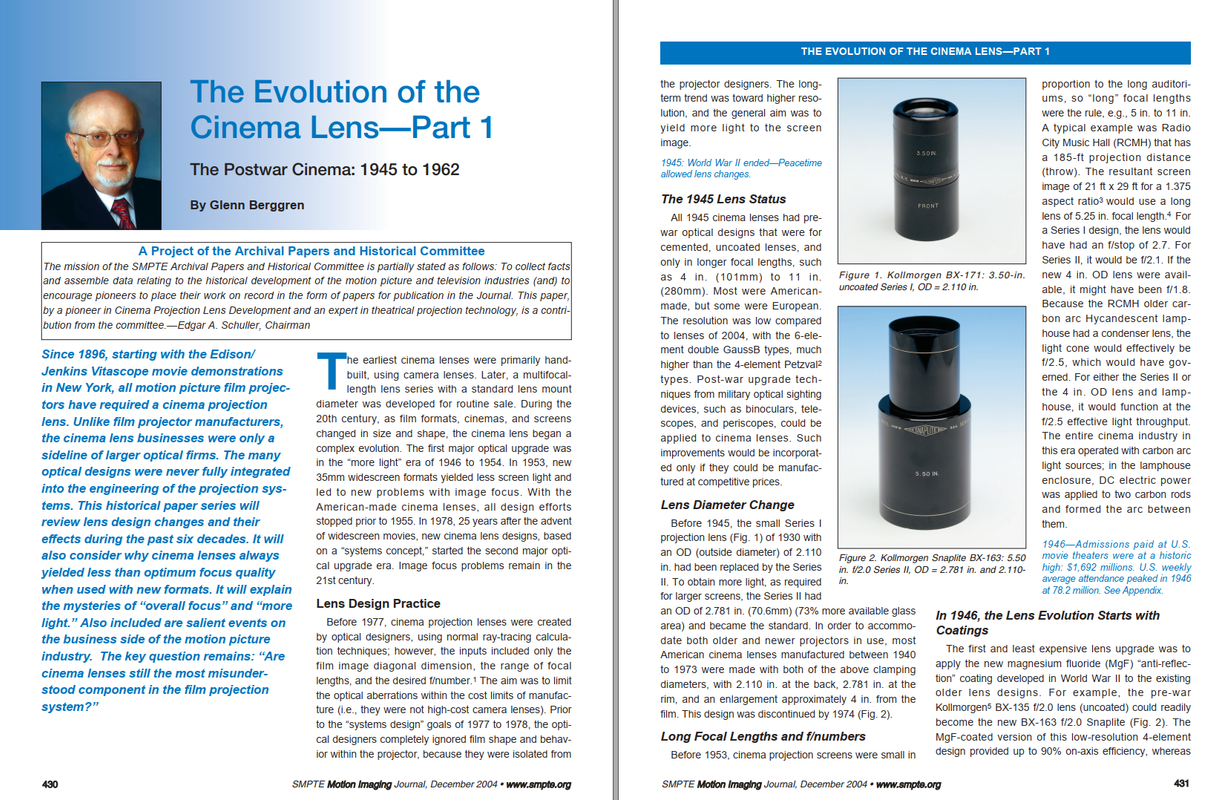
Download https://drive.google.com/file/d/1Ubz956KFU566qXxAet2HKHZWIQev2sIM/view?usp=sharing
Berggren, G., 2007. The Evolution of the Cinema Lens—Part 2: The Cinema Revival: 1962–1974. SMPTE motion imaging journal, 116(2-3), pp.87-103.
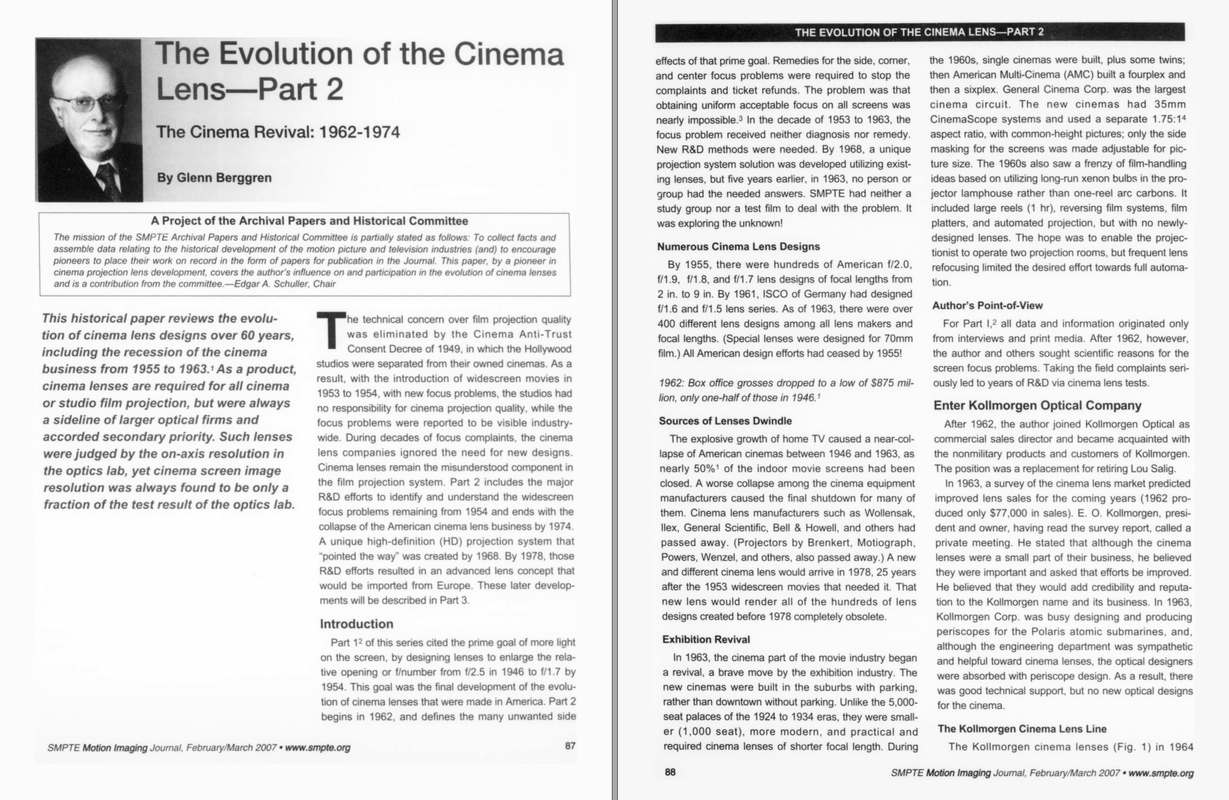
B&W scan from internet archive. Downloaded and processed with Scan Tailor Advanced, Pinga GUI to very lightly compress... etc.
Download https://drive.google.com/file/d/1MD_0vorP7falhiRcBF8W5KqF2lj9tWFm/view
A part 3 I cannot find. I would have to see if I could contact Glenn Berggren.
Macher, K., 1980. New Projection Lenses for 35-mm Cinema Projectors. SMPTE Journal, 89(6), pp.465-467.
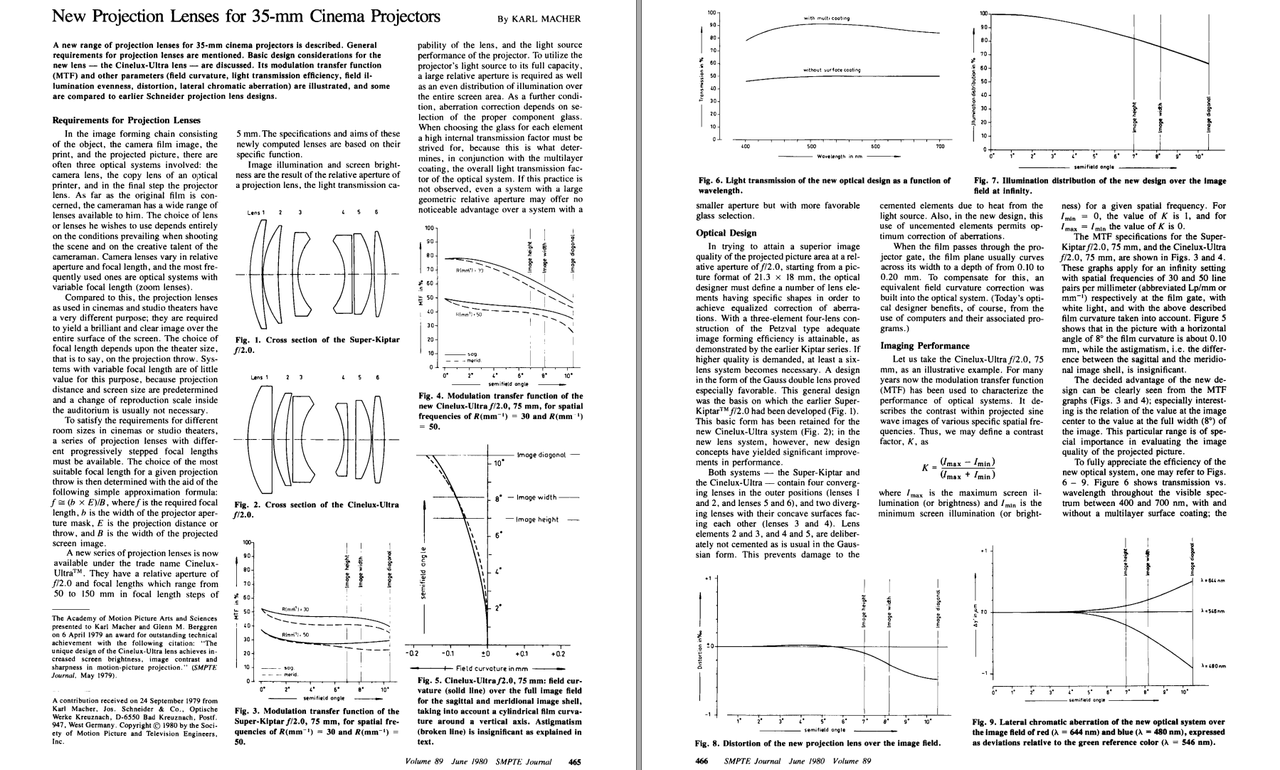
Abstract
| Citation: |
A new range of projection lenses for 35-mm cinema projectors is described. General requirements for projection lenses are mentioned. Basic design considerations for the new lens — the Cinelux-Ultra lens — are discussed. Its modulation transfer function (MTF) and other parameters (field curvature, light transmission efficiency, field illumination evenness, distortion, lateral chromatic aberration) are illustrated, and some are compared to earlier Schneider projection lens designs.
|
Download https://drive.google.com/file/d/1k6ghFugIEmN0BFpLrjdYWQf7FrNrHT4X/view?usp=sharing
Lisziewicz, H.A. and Linge, H., 1993. ISCO-OPTIC Ultra Star* HD projection lenses: a new generation of lenses for 35 and 70 mm film projection. Cinema Technology, 6(3), pp.170-2.
Citation only - I will need to get in contact with Cinema Technology magazine to look for their back issues (none on internet archive, can't find archival section of their website).
Berggren, G. (1989) ‘Ultra Star - The State of the Art In Projection Lenses’, in Presented at the 131st SMPTE technical conference, October 21-25, 1989, Los Angeles Convention Center, Los Angeles, Calif.. 31. White Plains, NY: The Society.
This was, as the citation suggests a manuscript/paper presented (not cancelled unlike some) at said SMPTE conference. I couldn't find a nice way to shoe in the paper number and code, which is 89SMPTE-31 Paper #54. It was Sunday Afternoon, Session A: Film Production / Presentation (at USC).
Judging by how the next conference was announced in 1991, they really do mean paper - required manuscripts to be submitted (provide 500 word synopsis amongst other things) that "may be supplemented by audiovisuals". If there really were more discussion based ones I don't think they would be under here.
But it was presented, there, and that's it - the paper/document not made available through some other means.
That "some other means" would be somewhat likely to be appearing in SMPTE journal, but as I should have expected, this wasn't automatic: next year's conference announcement mentions "all accepted papers will be considered for publication in the SMPTE Journal." And I'm forgetting the obvious: the authors would want to have to do it in the first place. For some that might mean modifying the content a bit, change/add to it for SMPTE publication, I don't know.
It also says "Manuscripts that are received by the deadline will be preprinted and sold at the conference." Using https://www.citethisforme.com/ I found that the pre-print exists in physical form in one American University library, which is understandable I guess for a trade journal?? I really can't generalise here..
It seemed to be a practice (whether as a result of an opt in or not) to have the sessions recorded on audiotape for you to buy. That was offered for this paper's session.
If you search "The State of the Art In Projection Lenses" on internet archive you will see everything I'm seeing.
https://www.youtube.com/watch?v=3SdU6hKsjrs
This is a video from www.iscoprecisionoptics.com (internet archive of it) that I have re-uploaded, which shows the The design and manufacture of ISCO lenses - predominantly the ULTRA-STAR 35mm projection ones, but also the 1.33x DLP home projection anamorphic attachments. The video file is named "iscoaward5_0001.wmv", seemingly in recognition of the Innovation Award it won in 2004 for two submissions, the ones I just mentioned.
I would do a Harvard reference but I would probably have to find where it was embedded on the website and then see how it was referred to. Whereas I just did a 'scrape' for all video formats on the internet archives' copy of the website.
There is an interesting focus on a computer screen with a lens cut-away / ray trace on it, that looked Double-Gauss, I wonder what's being designed and more importantly how far along it was though? 1:01 to 1:18
There was a Kollmorgen Projection Lenses Sales Brochure on eBay a while back that another member graciously offered to buy for me, but he has not been online for a couple of months (I responded very late).
I have somewhere the screenshot of Ultra-Star being trademarked (also found on Internet archive).
I will do a proper look for discussions from Kollmorgen on their lenses, if they exist, going off the timeline provided in The Evolution of the Cinema Lens. I didn't know they were the roots of Schneider.
Finally, I can upload all the .pdf content I've scraped from the relevant websites from internet archive. Granted, a lot available online. I can do that with some advertisements I've found. |

_________________
☮☮☮☮☮☮☮☮☮☮☮☮☮☮☮☮☮☮☮☮☮☮☮☮☮☮☮☮☮☮☮☮ like attracts like! ☮☮☮☮☮☮☮☮☮☮☮☮☮☮☮☮☮☮☮☮☮☮☮☮☮☮☮☮☮☮☮☮
Cameras: Sony ILCE-7RM2, Spotmatics II, F, and ESII, Nikon P4
Lenses:
M42 Asahi Optical Co., Takumar 1:4 f=35mm, 1:2 f=58mm (Sonnar), 1:2.4 f=58mm (Heliar), 1:2.2 f=55mm (Gaussian), 1:2.8 f=105mm (Model I), 1:2.8/105 (Model II), 1:5.6/200, Tele-Takumar 1:5.6/200, 1:6.3/300, Macro-Takumar 1:4/50, Auto-Takumar 1:2.3 f=35, 1:1.8 f=55mm, 1:2.2 f=55mm, Super-TAKUMAR 1:3.5/28 (fat), 1:2/35 (Fat), 1:1.4/50 (8-element), Super-Multi-Coated Fisheye-TAKUMAR 1:4/17, Super-Multi-Coated TAKUMAR 1:4.5/20, 1:3.5/24, 1:3.5/28, 1:2/35, 1:3.5/35, 1:1.8/85, 1:1.9/85 1:2.8/105, 1:3.5/135, 1:2.5/135 (II), 1:4/150, 1:4/200, 1:4/300, 1:4.5/500, Super-Multi-Coated Macro-TAKUMAR 1:4/50, 1:4/100, Super-Multi-Coated Bellows-TAKUMAR 1:4/100, SMC TAKUMAR 1:1.4/50, 1:1.8/55
M42 Carl Zeiss Jena Flektogon 2.4/35
Contax Carl Zeiss Vario-Sonnar T* 28-70mm F3.5-4.5
Pentax K-mount SMC PENTAX-A ZOOM 1:3.5 35~105mm, SMC PENTAX ZOOM 1:4 45~125mm
Nikon Micro-NIKKOR-P-C Auto 1:3.5 f=55mm, NIKKOR-P Auto 105mm f/2.5 Pre-AI (Sonnar), Micro-NIKKOR 105mm 1:4 AI, NIKKOR AI-S 35-135mm f/3,5-4,5
Solinon 1:5.6/18 ASPH.
Tamron SP 17mm f/3.5 (51B), Tamron SP 17mm f/3.5 (151B), SP 500mm f/8 (55BB), SP 70-210mm f/3.5 (19AH)
Vivitar 100mm 1:2.8 MC 1:1 Macro Telephoto (Kiron)
|
|
| Haut de page |
|
|
simple.joy
Inscrit le: 30 Mai 2022
Messages: 954
|
Posté: Dim Juil 02, 2023 4:13 pm Sujet du message: |
|
Posté: Dim Juil 02, 2023 4:13 pm Sujet du message: |
|
|
simple.joy wrote:
| stevemark a écrit: |
@ simple.joy:
It's always a joy to see your images - thanks for sharing!
S |
Thank you very much!
| 16:9 a écrit: |
| Thanks for that - one important thing to note when you're posting your serials - please be accurate about the naming of your lens: for instance, whether it is marked ISCO-GÖTTINGEN or ISCO-OPTIC (in the case of the 1970s lenses) or just ISCO (usually in the 1990s). |
Thanks for the reminder - both of mine are labeled Isco-Optic.
Got to agree here and add, that it's quite incredible what amount of knowledge, experience and resources this forum can produce in a short amount of time, when everyone is motivated to share and help out! I'm continually impressed and thankful for that and have learned quite a lot, despite being a bit late to the party! 😅

_________________
---
Manual lens enthusiast
https://www.flickr.com/photos/simple_joy/ |
|
| Haut de page |
|
|
eggplant
Inscrit le: 27 Mai 2020
Messages: 517
|
Posté: Mer Juil 05, 2023 10:22 pm Sujet du message: |
|
Posté: Mer Juil 05, 2023 10:22 pm Sujet du message: |
|
|
eggplant wrote:
Thanks all for the comments.
I will just quickly add what I omitted- all the articles can be found in internet archive's B&W scan of the SMPTE Journal, as they're all from there (free to read under loan).
The Evolution of the Cinema Lens - Part 1 The Postwar Cinema 1945 to 1962
https://archive.org/details/sim_smpte-motion-imaging-journal_2004-12_113_12/mode/2up
The Evolution of the Cinema Lens - Part 2 The Cinema Revival 1962–1974
https://archive.org/details/sim_smpte-motion-imaging-journal_february-march-2007_116_2-3/page/86/mode/2up
New Projection Lenses for 35-mm Cinema Projectors
https://archive.org/details/sim_smpte-motion-imaging-journal_1980-06_89_6/page/464/mode/2up
(Just edited my original post to say, the pdf offered of the last one was not taken from the internet archive copy, but downloaded from the DL link offered in the listing for the article on Google Scholar)
_________________
UK |
|
| Haut de page |
|
|
paulhofseth
Inscrit le: 05 Mar 2011
Messages: 620
Localisation: Norway
Expire: 2018-06-28
|
Posté: Jeu Juil 06, 2023 8:29 am Sujet du message: |
|
Posté: Jeu Juil 06, 2023 8:29 am Sujet du message: |
|
|
paulhofseth wrote:
Isco-optic ultra-star hd-plus -185 mc 2,1 , marked f 70mm 2,76in number 370037 in small type at the rear. Annoying that the optics cannot be extracted and put in a helix, but the "samtfocus" works and the sunshade of the ISCO construction is useful.
p |
|
| Haut de page |
|
|
16:9
Inscrit le: 04 Avr 2014
Messages: 319
Localisation: UK
|
Posté: Jeu Juil 06, 2023 4:54 pm Sujet du message: |
|
Posté: Jeu Juil 06, 2023 4:54 pm Sujet du message: |
|
|
16:9 wrote:
I'd like to post a draft version of the concluding summary of the Delta article, which I hope gives a new, more accurate overview of how Isco and Schneider lenses inter-relate. Happy for anyone to point out errors or omissions (there will be many omissions – it's a very brief summary of a much longer article). These are the boiled-down facts, as far as I know. There's a lot more to say about differences between specific models before coming to a conclusion about what's 'best', but the chronology does most of the work there.
-------------
Summary Conclusion:
----------
Although Kollmorgen began the Cinelux story, the first generation, single-coated Kollmorgen Cinelux f1.9 was a rebranded 1952 design (BX 241) and barely deserves the name. Isco's 1973 upgrade – the second generation, multi-coated Isco-Göttingen Cinelux MC f2.0 – was only a modest improvement.
The magic happens in the third generation, specifically in 1977, with the release of Isco's 1978-Oscar-winning six-element / four group Isco-Göttingen Cinelux-Ultra, AKA (post-1982/3) Isco-Optic Ultra MC and Schneider Cinelux-Ultra.
Fourth generation lenses of 1985-1995 improved on third-generation models. Although launched almost simultaneously in 1985, the Oscar-winning, seven-element Isco-Optic Ultra-Star HD was considered superior to the six-element / six-group Schneider Cine-Xenon and dominated it commercially. Cine-Xenon was only released in focal lengths ≤ 100mm. In both ranges, sub-45mm lenses had more elements. Third generation models (Isco-Optic Ultra MC and Schneider Cinelux-Ultra) were still sold as 'entry-level' models and received improved coatings.
Fifth-generation models (1995-2005) took a step forward again, with better coatings and supercomputer-assisted formulation. The seven-element Schneider Super-Cinelux supplanted Cine-Xenon in 1995. Cinelux-Ultra was refreshed, recoated and restricted to being a roster of six-element 105-180mm lenses subtly retitled Schneider Cinelux-Ultra 35/70. The flagship seven-element Isco Ultra-Star HD Plus was released in 1998 and sold alongside UltraStar HD and Ultra MC. During this period Isco evolved Ultra-Star HD into Ultra-Star Studio derivatives with smaller apertures, and Schneider released 870 and 70mm-specific variants. In 2000 Isco and Schneider both took home Oscars for UltraStar HD* Plus and Super-Cinelux. Those lenses can be considered equals at (almost) the top of the table.
We can view the Schneider Cinelux-Première (debuted in 2002) as the start of a sixth and final generation, and easily the best of its type – in a category of its own – with aspherical elements and a variable f1.7-4.0 iris. Isco's UltraStar HD range was discontinued in 2006, but a version of the the Ultra MC (now 6/6 and with improved coatings) remained in production until Isco's reabsorption by Schneider in 2008. Sometime after 2005, Schneider dropped Super- and late, orange/gold lenses were simply branded Cinelux. In 2011/12, (mysteriously deep into the digital era) Schneider discontinued all other versions and launched a new Cinelux-Ultra [V3] that broke tradition by being all-black with a grey nose. It was accompanied by UltraStar and Ultra-Black Star anamorphic attachments in honour of Isco and was listed in the Schneider catalogue as late as 2017, exactly 40 years after the first Oscar-winning Cinelux.
_________________
If it ain't broke, break it.
Dernière modification par 16:9 le Jeu Juil 06, 2023 4:57 pm ; modifié 1 fois au total |
|
| Haut de page |
|
|
simple.joy
Inscrit le: 30 Mai 2022
Messages: 954
|
Posté: Jeu Juil 06, 2023 4:56 pm Sujet du message: |
|
Posté: Jeu Juil 06, 2023 4:56 pm Sujet du message: |
|
|
simple.joy wrote:
| paulhofseth a écrit: |
Isco-optic ultra-star hd-plus -185 mc 2,1 , marked f 70mm 2,76in number 370037 in small type at the rear. Annoying that the optics cannot be extracted and put in a helix, but the "samtfocus" works and the sunshade of the ISCO construction is useful.
p |
Thanks! Mine is almost identical including the -185... but I have the 75 mm version.
@16:9: What does the -185 stand for? It's a great lens, however it definitely shows some CAs.
I love how the Isco Ultra-Star lenses look and feel. Even inspired me to use them in a couple of shots:
The red one as a "taurus":
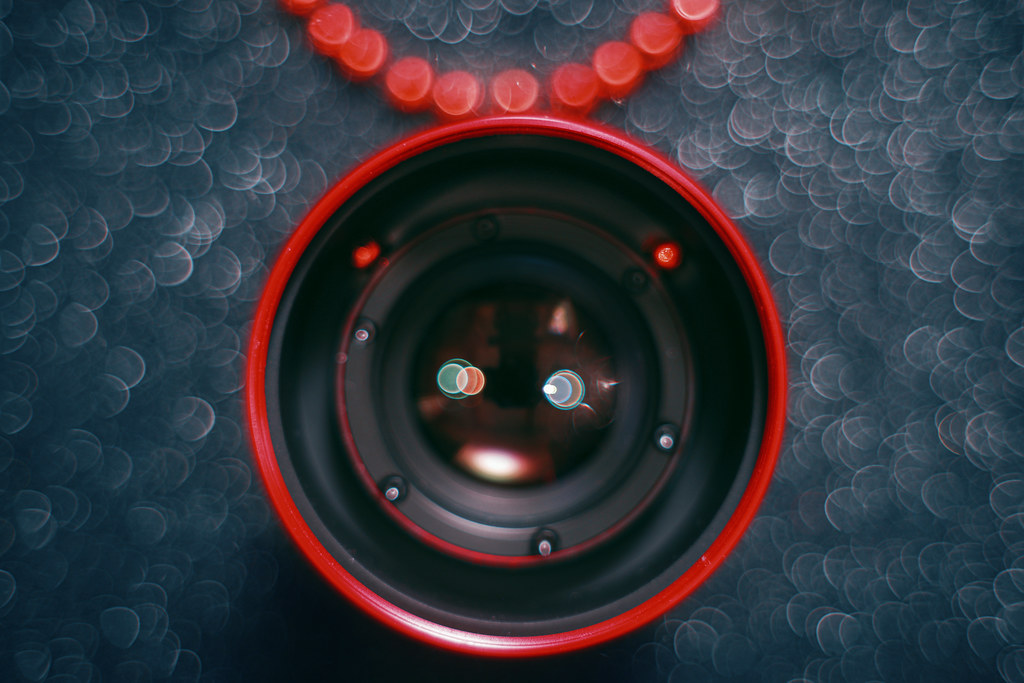 Taurus: a lack of ideas makes me see red by simple.joy, on Flickr
The golden one as a "cup of light":
 Light cocktail by simple.joy, on Flickr
Both of those shots were captured with a Meyer Domiron though... 😉
Here are a couple more captures with Schneider/Isco lenses:
Schneider Kreuznach AV-Xenotar 90 mm f/2.4-8
 Eye know, you see? by simple.joy, on Flickr
That's a really sharp lens, and quite versatile with its variable aperture.
Here's one I forgot about when I listed my lenses, because it was a gift and not labeled. I found the ring though, and it seems to be a
Isco-Göttingen Super-Kiptar 70 mm f/2
 A forks for good by simple.joy, on Flickr
And finally a couple more with the Isco-Optic Ultra-Star HD Plus 75 mm f/2.1:

https://live.staticflickr.com/65535/53027627500_2e677a45eb_3k.jpg

https://live.staticflickr.com/65535/53027404269_1006dd7289_3k.jpg

https://live.staticflickr.com/65535/53027629015_da2ea6217e_3k.jpg
_________________
---
Manual lens enthusiast
https://www.flickr.com/photos/simple_joy/ |
|
| Haut de page |
|
|
eggplant
Inscrit le: 27 Mai 2020
Messages: 517
|
Posté: Jeu Juil 06, 2023 5:48 pm Sujet du message: |
|
Posté: Jeu Juil 06, 2023 5:48 pm Sujet du message: |
|
|
eggplant wrote:
| paulhofseth a écrit: |
Isco-optic ultra-star hd-plus -185 mc 2,1 , marked f 70mm 2,76in number 370037 in small type at the rear. Annoying that the optics cannot be extracted and put in a helix, but the "samtfocus" works and the sunshade of the ISCO construction is useful.
p |
I am not sure what more you want, or what you have in mind. They come in a single cell. Below my 85mm
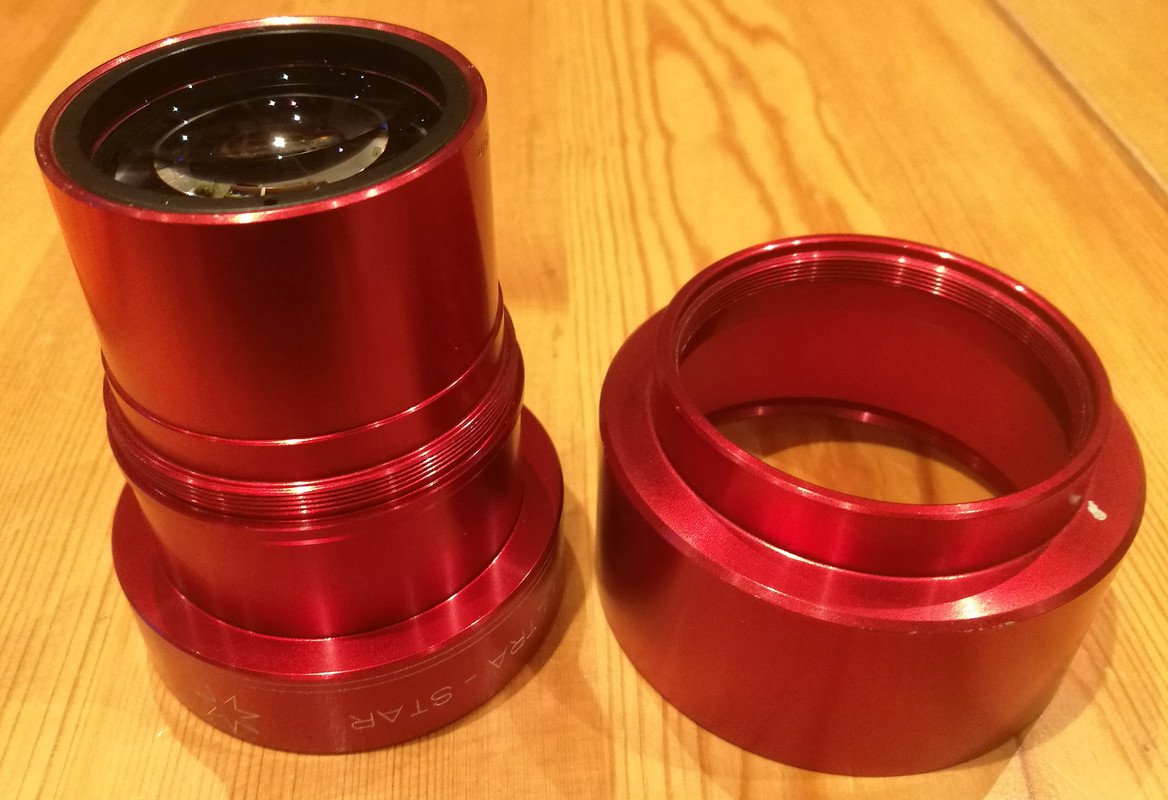
_________________
UK |
|
| Haut de page |
|
|
16:9
Inscrit le: 04 Avr 2014
Messages: 319
Localisation: UK
|
Posté: Jeu Juil 06, 2023 8:33 pm Sujet du message: |
|
Posté: Jeu Juil 06, 2023 8:33 pm Sujet du message: |
|
|
16:9 wrote:
| paulhofseth a écrit: |
| Isco-optic ultra-star hd-plus -185 mc 2,1 , marked f 70mm 2,76in number 370037 in small type at the rear. Annoying that the optics cannot be extracted and put in a helix, but the "samtfocus" works and the sunshade of the ISCO construction is useful. |
Thanks for that - serial noted.
_________________
If it ain't broke, break it. |
|
| Haut de page |
|
|
16:9
Inscrit le: 04 Avr 2014
Messages: 319
Localisation: UK
|
Posté: Jeu Juil 06, 2023 10:16 pm Sujet du message: |
|
Posté: Jeu Juil 06, 2023 10:16 pm Sujet du message: |
|
|
16:9 wrote:
Updated
_________________
If it ain't broke, break it.
Dernière modification par 16:9 le Mar Juil 11, 2023 9:51 pm ; modifié 1 fois au total |
|
| Haut de page |
|
|
16:9
Inscrit le: 04 Avr 2014
Messages: 319
Localisation: UK
|
Posté: Jeu Juil 06, 2023 10:28 pm Sujet du message: |
|
Posté: Jeu Juil 06, 2023 10:28 pm Sujet du message: |
|
|
16:9 wrote:
@ SimpleJoy: All the the Isco-Optic Ultra-Star* HD Plus were f1.8, but came with screw-in stops (an optional accessory). Common configurations were f2.1 and f2.4. If you unscrew the stop, you have an f1.8 again.
_________________
If it ain't broke, break it.
Dernière modification par 16:9 le Mar Juil 11, 2023 9:52 pm ; modifié 1 fois au total |
|
| Haut de page |
|
|
eggplant
Inscrit le: 27 Mai 2020
Messages: 517
|
Posté: Jeu Juil 06, 2023 10:36 pm Sujet du message: |
|
Posté: Jeu Juil 06, 2023 10:36 pm Sujet du message: |
|
|
eggplant wrote:
Well, that only went on the front, I can't say that's the most accurate position but if your'e just looking for brightness...
_________________
UK |
|
| Haut de page |
|
|
scratchpaddy
Inscrit le: 25 Jan 2022
Messages: 7
Localisation: Phoenix
|
Posté: Dim Juil 09, 2023 4:36 pm Sujet du message: |
|
Posté: Dim Juil 09, 2023 4:36 pm Sujet du message: |
|
|
scratchpaddy wrote:
Okay, I've been meaning to join these forums for years now, and 16:9 finally pulled me in from another forum for this discussion. So much great historical information here. I've learned so much already. I do have a few things I think I can add from my own research over the past few years.
| 16:9 a écrit: |
| Although Kollmorgen began the Cinelux story, the first generation, single-coated Kollmorgen Cinelux f1.9 was a rebranded 1952 design (BX 241) and barely deserves the name. |
Per the Berggren articles Eggplant linked to, the BX-241 design, 6 elements in 4 groups, is from 1948. I can confirm this personally, since I have a BX-241 copy made in Brooklyn, New York - so it predates Kollmorgen's move to Northampton in 1950. I can also confirm that it's not a good lens.
| 16:9 a écrit: |
| The magic happens in the third generation, specifically in 1977, with the release of Isco's 1978-Oscar-winning six-element / four group Isco-Göttingen Cinelux-Ultra, AKA (post-1982/3) Isco-Optic Ultra MC and Schneider Cinelux-Ultra. |
I'm sure you mean 6 elements in 6 groups? None of the ISCO/Schneider designs ever used cemented elements, which is a very important point. Thanks to that detail, most of these lenses perform just as well as the day they were made. The older Kollmorgen designs did use cemented elements, which the concentrated heat of the projector lamps quickly destroyed. It's hard to find copies of those lenses today without cloudy, delaminated elements.
I don't know how much detail you want to get into on optical formulas, but the Ultra-Star (Plus) used both a 9-element and 7-element formula depending on the focal length, and the Super-Cinelux picture is even more complicated. I'll see if I can make another post that summarizes the different designs.
| 16:9 a écrit: |
| @ SimpleJoy: Most of the the Isco-Optic Ultra-Star HD* Plus were f1.85, but came with screw-in stops (an optional accessory). Common configurations were f2.1 and f2.4. If you unscrew the stop, you have an f1.85 again. |
The one lens I have that includes this ring reads "HD - PLUS - 1.85 MC 2,1". Looking closely, 1.85 uses a period, while 2,1 uses a comma (as Europeans typically do for decimals), which makes me think they refer to two different things. 2,1 is definitely the aperture, so I don't know for sure, but I believe 1.85 refers to aspect ratio: 1.85 is the most common widescreen cinema format. Wider aspect ratios would require an anamorphic attachment, and the ring on which "1.85" is engraved would be removed in order to attach the anamorphic add-on. |
|
| Haut de page |
|
|
scratchpaddy
Inscrit le: 25 Jan 2022
Messages: 7
Localisation: Phoenix
|
Posté: Dim Juil 09, 2023 5:48 pm Sujet du message: |
|
Posté: Dim Juil 09, 2023 5:48 pm Sujet du message: |
|
|
scratchpaddy wrote:
ISCO Cinelux-Ultra, from an article Eggplant already linked to above, written by the designer of the lens, Karl Macher. The copy I originally found was here: New Projection Lenses for 35-mm Cinema Projectors. I know the 60mm Cinelux-Ultra covers a full-frame (24x36) photographic sensor, but I'm not sure if shorter focal lengths exist, and if they do, how big the image circle is. Generally, the image circle grows larger with longer focal lengths. I'm not sure what the minimum focal length is to cover digital medium format (33x44).

Schneider Super Cinelux, 60mm to 100mm, 6 elements (source: Super 35 Cinelux). All focal lengths cover full frame.

Schneider Super Cinelux, 42.5mm to 55mm, 7 elements (same source as above). Does not cover full frame.

Schneider Super Cinelux, 28mm to 40mm, 7 elements (source: Schneider Innovations). Likely does not cover full frame.

Schneider Super Cinelux, 24mm to 26mm, 8 elements (same source as above). Likely does not cover full frame.

ISCO Ultra Star Plus, 25mm to 45mm (source: US Patent 6,801,373 B2). The gold, non-"Plus" version does not cover full frame. I'm not sure about the "Plus", and I'm unwilling to buy one to test. These nine-element lenses are gigantic and heavy, nearly 1 kilogram.

Isco Ultra Star Plus, 47.5mm to 95mm (source: US Patent 6,795,255 B2). All focal lengths of the red, "Plus" version cover full frame. I'm not sure what the minimum focal length is for full frame coverage on the gold, non-"Plus" lenses.

I could never find any diagrams of the original Ultra-Star, but as far as I know, the "Plus" had the same basic formula as the original line, except the diameter of the rear elements was increased significantly. |
|
| Haut de page |
|
|
|
|
 Français
 Español
 中文
 Magyar
 Русский
 Deutsch
 日本語



