| Voir le sujet précédent :: Voir le sujet suivant |
| Auteur |
Message |
simple.joy 


Inscrit le: 30 Mai 2022
Messages: 954
|
 Posté: Lun Août 26, 2024 3:52 pm Sujet du message: Taylor Hobson Cooke Anastigmat Special Lens 12.5 mm f/2.5 |
|
Posté: Lun Août 26, 2024 3:52 pm Sujet du message: Taylor Hobson Cooke Anastigmat Special Lens 12.5 mm f/2.5 |
|
|
simple.joy wrote:
I stumbled upon this lens a while ago, but due to its limits in terms of use case, I've not used it a lot. I've been familar with Taylor-Hobson, own and love a couple of their lenses (particularly the Ental II) and while many of their cine offerings seem somewhat overpriced today, there are still a couple of lesser known interesting lenses well worth of giving a try.
When I recently found out that another forum member (e6filmuser) has got one of these small lenses as well, I decided to get it out again and also upload the little I know here in the forum. Perhaps someone else has some more details as well, so we can assemble all of that in one place. So far I haven't been able to fint much on it.
Here's how it looks like:


The name is interesting:
Cooke Anastigmat Special Lens 12 1/2 MM f/2.5, Mady by Taylor Hobson
It's small size factor, shape and seemingly optimization for macro photography immediately reminded me of the great Carl Zeiss Luminar series and just like a couple of those, it also seems to be based on a very simple lens design. It's hard to say for sure, just judging by reflections, but I think that it is a Triplet (as the name probably suggests as well - I'm not sure about how consistent these terms were used at the time...). With its focal length of 12.5 mm and a wide open aperture of f/2.5 it certainly seems to have been designed for high magnification macro applications. I'm not sure about the coverage, but it seems to cover full frame at what I assume to be the intended magnification factors.
The thread of the lens does seem to be a non-metric standard. Because I have some retaining rings from other Taylor-Hobson lenses, I'm pretty sure it's a
1.25” 24TPI thread. That thread seems close enough to fit onto a M32x1 mm adapter, but it's not an exact fit, so it might impact lens performance negatively... I'm not sure yet.
I'm not sure how old this lens is, but I would guess it's pretty old, judging by its appearance. Perhaps the markings/company name etc. might give some indication - I'm not well-versed enough in the lore of the UK optical industry to know for sure.
Because I haven't used this lens a lot, I don't have any verdict on its abilities... it seems pretty capable though, particularly when it's stopped down slightly. And of course, at 12.5 mm it's possible to get extremely close without a lot of extension, which is really fun.
Here are some samples:
 Graphite or flight by simple.joy, on Flickr

(FOV around 7 mm)

(FOV around 8 mm)
I don't have a lot of lenses to compare it with directly, because of its short focal length. The closest is probably a Carl Zeiss Luminar 16 mm and I'm currently not able to use either one of the lenses as effectively as it would be necessary for a good comparison. Perhaps I'll get to it in the future.
If you know anything about this unusual little lens, please let me know - I'd be curious to get a better understanding about its history, construction and original application!
_________________
---
Manual lens enthusiast
https://www.flickr.com/photos/simple_joy/ |
|
| Haut de page |
|
 |
caspert79


Inscrit le: 31 Oct 2010
Messages: 3916
Localisation: The Netherlands
|
Posté: Lun Août 26, 2024 4:28 pm Sujet du message: |
|
Posté: Lun Août 26, 2024 4:28 pm Sujet du message: |
|
|
caspert79 wrote:
Nice images, surprising quality! |
|
| Haut de page |
|
|
e6filmuser
Inscrit le: 12 Nov 2010
Messages: 1159
Localisation: Reading UK
|
Posté: Lun Août 26, 2024 6:12 pm Sujet du message: |
|
Posté: Lun Août 26, 2024 6:12 pm Sujet du message: |
|
|
e6filmuser wrote:
I have used this lens only once, having searched for it for years.
I used it mounted on my Sony A7r but here it is shown on the A7r3.
The constituent items enabling it to be used on the E mount are:
M32x1 to M42x1 step down, made by RAFCAMERA
52mm to 42mm step down
57mm to 52mm step down
Sony E to 57mm (very tight fit)
Slime mould Trichia persimilis


_________________
Dedicated to using manual focus lenses with digital. Equiped for photography from macro to panoramic & from ultra-wide to extreme telephoto. Mostly shooting outdoor macro. Experienced entomological taxonomist. Some knowledge of mushrooms.
Dernière modification par e6filmuser le Mar Août 27, 2024 5:55 am ; modifié 1 fois au total |
|
| Haut de page |
|
|
visualopsins

Inscrit le: 05 Mar 2009
Messages: 11706
Localisation: California
Expire: 2027-07-11
|
Posté: Lun Août 26, 2024 7:17 pm Sujet du message: |
|
Posté: Lun Août 26, 2024 7:17 pm Sujet du message: |
|
|
visualopsins wrote:
Pretty amazing specs for so old lens!
So wide! 12-1/2 MM So fast! f/2.5 That wide and fast probaby for LF camera! What is not amazing?
_________________
☮☮☮☮☮☮☮☮☮☮☮☮☮☮☮☮☮☮☮☮☮☮☮☮☮☮☮☮☮☮☮☮ like attracts like! ☮☮☮☮☮☮☮☮☮☮☮☮☮☮☮☮☮☮☮☮☮☮☮☮☮☮☮☮☮☮☮☮
Cameras: Sony ILCE-7RM2, Spotmatics II, F, and ESII, Nikon P4
Lenses:
M42 Asahi Optical Co., Takumar 1:4 f=35mm, 1:2 f=58mm (Sonnar), 1:2.4 f=58mm (Heliar), 1:2.2 f=55mm (Gaussian), 1:2.8 f=105mm (Model I), 1:2.8/105 (Model II), 1:5.6/200, Tele-Takumar 1:5.6/200, 1:6.3/300, Macro-Takumar 1:4/50, Auto-Takumar 1:2.3 f=35, 1:1.8 f=55mm, 1:2.2 f=55mm, Super-TAKUMAR 1:3.5/28 (fat), 1:2/35 (Fat), 1:1.4/50 (8-element), Super-Multi-Coated Fisheye-TAKUMAR 1:4/17, Super-Multi-Coated TAKUMAR 1:4.5/20, 1:3.5/24, 1:3.5/28, 1:2/35, 1:3.5/35, 1:1.8/85, 1:1.9/85 1:2.8/105, 1:3.5/135, 1:2.5/135 (II), 1:4/150, 1:4/200, 1:4/300, 1:4.5/500, Super-Multi-Coated Macro-TAKUMAR 1:4/50, 1:4/100, Super-Multi-Coated Bellows-TAKUMAR 1:4/100, SMC TAKUMAR 1:1.4/50, 1:1.8/55
M42 Carl Zeiss Jena Flektogon 2.4/35
Contax Carl Zeiss Vario-Sonnar T* 28-70mm F3.5-4.5
Pentax K-mount SMC PENTAX-A ZOOM 1:3.5 35~105mm, SMC PENTAX ZOOM 1:4 45~125mm
Nikon Micro-NIKKOR-P-C Auto 1:3.5 f=55mm, NIKKOR-P Auto 105mm f/2.5 Pre-AI (Sonnar), Micro-NIKKOR 105mm 1:4 AI, NIKKOR AI-S 35-135mm f/3,5-4,5
Solinon 1:5.6/18 ASPH.
Tamron SP 17mm f/3.5 (51B), Tamron SP 17mm f/3.5 (151B), SP 500mm f/8 (55BB), SP 70-210mm f/3.5 (19AH)
Vivitar 100mm 1:2.8 MC 1:1 Macro Telephoto (Kiron)
|
|
| Haut de page |
|
|
stevemark
Inscrit le: 29 Avr 2011
Messages: 5511
Localisation: Switzerland
|
Posté: Lun Août 26, 2024 8:50 pm Sujet du message: |
|
Posté: Lun Août 26, 2024 8:50 pm Sujet du message: |
|
|
stevemark wrote:
| visualopsins a écrit: |
Pretty amazing specs for so old lens!
So wide! 12-1/2 MM |
It' NOT wide at all. Yes, it has 12.5 mm focal length (which determines the size of the projection of a given object). Its angle of view however is more or less that of a normal lens, maybe even less. At infinity it would NEVER cover 24x36mm, let alone Large Format (LF).
| visualopsins a écrit: |
| So fast! f/2.5 That wide and fast probaby for LF camera! What is not amazing? |
The speed of a lens is determined by the ratio of its focal length divided by the diameter of its effective opening.
If this lens has a focal length of 12.5mm, and a speed of 2.5, the effective diameter at f2.5 will be 5mm. Since this lens will be used as a macro/micro lens (and thus much further away from the film/sensor, compared to a use near infinity), the perceived diameter of the aperture opening will be even smaller (much smaller indeed). Such small diameters will cause quite a bit of diffraction, even if the lens is used wide open. That's why such lenses have to be fast.
If you look at such macro/micro lenses, they usually are f2. Stopping them down to e. g. f5,6 or f8 at an image/object ratio of 20:1 will cause massive issues with diffraction. That's why - these days - most serious photographers are into stacking when doing real macro work ... shoot wide open to limit diffraction, and stack several (or even dozens) of images to get depth-of-field ...
I have been using the Canon FD 3.5/20mm Macro lens occasionally, just for fun, and no stacking involved. Using it at about 20:1 and f8 (to get at least some depth-of-field), its effective resolution is limited to about 1 megapixel ... (due to diffraction, not because the lens is bad!!). See image below:

Above: Tiny crystal of monazite, which used to be the most important source of rare earth elements such as lanthanum, cerium and neodymium. Usually found as dull brown opaque masses, the mineral can form beautiful shiny crystals such as this one found in the Val Nalps near San Gottadro in Switzerland.
S
_________________
www.artaphot.ch |
|
| Haut de page |
|
|
simple.joy
Inscrit le: 30 Mai 2022
Messages: 954
|
Posté: Lun Août 26, 2024 9:41 pm Sujet du message: |
|
Posté: Lun Août 26, 2024 9:41 pm Sujet du message: |
|
|
simple.joy wrote:
| stevemark a écrit: |
It' NOT wide at all. Yes, it has 12.5 mm focal length (which determines the size of the projection of a given object). Its angle of view however is more or less that of a normal lens, maybe even less. At infinity it would NEVER cover 24x36mm, let alone Large Format (LF).
| visualopsins a écrit: |
| So fast! f/2.5 That wide and fast probaby for LF camera! What is not amazing? |
The speed of a lens is determined by the ratio of its focal length divided by the diameter of its effective opening.
If this lens has a focal length of 12.5mm, and a speed of 2.5, the effective diameter at f2.5 will be 5mm. Since this lens will be used as a macro/micro lens (and thus much further away from the film/sensor, compared to a use near infinity), the perceived diameter of the aperture opening will be even smaller (much smaller indeed). Such small diameters will cause quite a bit of diffraction, even if the lens is used wide open. That's why such lenses have to be fast.
|
Thanks for clarifying and agreed - it's not at all like a wide angle lens for infinity work. Seems very, very different.
| stevemark a écrit: |
If you look at such macro/micro lenses, they usually are f2. Stopping them down to e. g. f5,6 or f8 at an image/object ratio of 20:1 will cause massive issues with diffraction. That's why - these days - most serious photographers are into stacking when doing real macro work ... shoot wide open to limit diffraction, and stack several (or even dozens) of images to get depth-of-field ...
I have been using the Canon FD 3.5/20mm Macro lens occasionally, just for fun, and no stacking involved. Using it at about 20:1 and f8 (to get at least some depth-of-field), its effective resolution is limited to about 1 megapixel ... (due to diffraction, not because the lens is bad!!). See image below:
Above: Tiny crystal of monazite, which used to be the most important source of rare earth elements such as lanthanum, cerium and neodymium. Usually found as dull brown opaque masses, the mineral can form beautiful shiny crystals such as this one found in the Val Nalps near San Gottadro in Switzerland.
S |
Nice shot! That Canon lens is still considered a very good one. It beats the MP-E 65 mm clearly at certain magnifications, even though it's so small.
| caspert79 a écrit: |
| Nice images, surprising quality! |
Thanks a lot! I don't think it does hold up compared to more modern specialized high magnifcation macro lenses, but it has great coverage and very even performance. If it's as old as I suspect, it's quite a good lens indeed.
| e6filmuser a écrit: |
I used it mounted on my Sony A7r but here it is shown on the A7r3.
The constituent items enabling it to be used on the E mount are:
M32x1 to M42x1 step down, made by RAFCAMERA
52mm to 42mm step down
57mm to 52mm step down
Sony E to 57mm (very tight fit)
|
Thanks a lot for the additional information and showing your solution for adapting this lens. Of course I'm using it on my bellows so mine is slightly different.
| e6filmuser a écrit: |
I have used this lens only once, having searched for it for years.
|
Wait... are you saying you knew about that lens beforehand? If so, from where? Are you aware of any spec sheets or mentions of this lens in any kind of literature, price list etc.?
_________________
---
Manual lens enthusiast
https://www.flickr.com/photos/simple_joy/ |
|
| Haut de page |
|
|
stevemark
Inscrit le: 29 Avr 2011
Messages: 5511
Localisation: Switzerland
|
Posté: Lun Août 26, 2024 10:22 pm Sujet du message: |
|
Posté: Lun Août 26, 2024 10:22 pm Sujet du message: |
|
|
stevemark wrote:
| simple.joy a écrit: |
Wait... are you saying you knew about that lens beforehand? If so, from where? Are you aware of any spec sheets or mentions of this lens in any kind of literature, price list etc.? |
Developped by Horace William Lee of TTH in 1933. Lens section below.

Refractive index of the positive front lens between 1.57 and 1.6, that of the rear positive lens >1.57.
S
_________________
www.artaphot.ch |
|
| Haut de page |
|
|
simple.joy
Inscrit le: 30 Mai 2022
Messages: 954
|
Posté: Lun Août 26, 2024 10:25 pm Sujet du message: |
|
Posté: Lun Août 26, 2024 10:25 pm Sujet du message: |
|
|
simple.joy wrote:
| stevemark a écrit: |
| simple.joy a écrit: |
Wait... are you saying you knew about that lens beforehand? If so, from where? Are you aware of any spec sheets or mentions of this lens in any kind of literature, price list etc.? |
Developped by Horace William Lee of TTH in 1933. Lens section below.
Refractive index of the positive front lens between 1.57 and 1.6, that of the rear positive lens >1.57.
S |
Thank you very much! I tried looking up the patent mentioned on the lens, but it was either some very general patent or my search results flawed.
_________________
---
Manual lens enthusiast
https://www.flickr.com/photos/simple_joy/ |
|
| Haut de page |
|
|
Doc Sharptail

Inscrit le: 23 Nov 2020
Messages: 1504
Localisation: Winnipeg Canada
|
Posté: Mar Août 27, 2024 4:34 am Sujet du message: |
|
Posté: Mar Août 27, 2024 4:34 am Sujet du message: |
|
|
Doc Sharptail wrote:
I wonder what the metallic device around that front element is.
Lens above sort of reminds me of the old Macro-Nikkor series- tiny lenses of fairly large maximum aperture...
-D.S.
_________________
D-810, F2, FTN, FT-3 in Black
35mm f2 O.C. nikkor
50 f2 H nikkor, 50 f2 H.C. nikkor, 50 f 1.4 AI-s, 135 f3.5 Q,
50 f2 K nikkor 2x, 28-85mm f3.5-4.5 A/I-s, 35-105 3.5-4.5 A/I-s, 200mm f4 Micro A/I, partial list.
"Ain't no half-way" -S.R.V.
"Oh Yeah... Alright" -Paul Simon |
|
| Haut de page |
|
|
e6filmuser
Inscrit le: 12 Nov 2010
Messages: 1159
Localisation: Reading UK
|
Posté: Mar Août 27, 2024 5:22 am Sujet du message: |
|
Posté: Mar Août 27, 2024 5:22 am Sujet du message: |
|
|
e6filmuser wrote:
| Doc Sharptail a écrit: |
I wonder what the metallic device around that front element is.
Lens above sort of reminds me of the old Macro-Nikkor series- tiny lenses of fairly large maximum aperture...
-D.S. |
Do you mean the aperture ring?
_________________
Dedicated to using manual focus lenses with digital. Equiped for photography from macro to panoramic & from ultra-wide to extreme telephoto. Mostly shooting outdoor macro. Experienced entomological taxonomist. Some knowledge of mushrooms. |
|
| Haut de page |
|
|
e6filmuser
Inscrit le: 12 Nov 2010
Messages: 1159
Localisation: Reading UK
|
Posté: Mar Août 27, 2024 5:39 am Sujet du message: |
|
Posté: Mar Août 27, 2024 5:39 am Sujet du message: |
|
|
e6filmuser wrote:
| e6filmuser a écrit: |
I have used this lens only once, having searched for it for years.
I used it mounted on my Sony A7r but here it is shown on the A7r3.
The constituent items enabling it to be used on the E mount are:
M32x1 to M42x1 step down, made by RAFCAMERA
52mm to 42mm step down
57mm to 52mm step down
Sony E to 57mm (very tight fit)
|
Here are some images of a slime mould Trichia persimilis from the above setup but A7r, not A7r3:
Taylor Taylor Hobson Cooke Anastigmat 12.5mm at f11, on A7R, 35mm from sensor, FOV 10mm wide. Twin TTL flash.

Crosseye stereo.

This was with the back of the lens ca 35mm from the sensor, the first session being 45mm away:

_________________
Dedicated to using manual focus lenses with digital. Equiped for photography from macro to panoramic & from ultra-wide to extreme telephoto. Mostly shooting outdoor macro. Experienced entomological taxonomist. Some knowledge of mushrooms.
Dernière modification par e6filmuser le Mar Août 27, 2024 5:59 am ; modifié 3 fois au total |
|
| Haut de page |
|
|
e6filmuser
Inscrit le: 12 Nov 2010
Messages: 1159
Localisation: Reading UK
|
Posté: Mar Août 27, 2024 5:51 am Sujet du message: |
|
Posté: Mar Août 27, 2024 5:51 am Sujet du message: |
|
|
e6filmuser wrote:
On the Olympus EM-1, FOV ca 4mm wide, f11, triple flash:
Slime mould Trichia decipiens
Crosseye stereo.

That gives similar results to my best macro lenses.
_________________
Dedicated to using manual focus lenses with digital. Equiped for photography from macro to panoramic & from ultra-wide to extreme telephoto. Mostly shooting outdoor macro. Experienced entomological taxonomist. Some knowledge of mushrooms. |
|
| Haut de page |
|
|
e6filmuser
Inscrit le: 12 Nov 2010
Messages: 1159
Localisation: Reading UK
|
|
| Haut de page |
|
|
simple.joy
Inscrit le: 30 Mai 2022
Messages: 954
|
|
| Haut de page |
|
|
alex ph
Inscrit le: 16 Mar 2013
Messages: 1802
|
Posté: Mar Août 27, 2024 11:09 am Sujet du message: |
|
Posté: Mar Août 27, 2024 11:09 am Sujet du message: |
|
|
alex ph wrote:
Great shots, and what a level of detail! |
|
| Haut de page |
|
|
Himself
Inscrit le: 01 Mar 2007
Messages: 3316
Localisation: Montreal
Expire: 2013-05-30
|
Posté: Mar Août 27, 2024 12:13 pm Sujet du message: |
|
Posté: Mar Août 27, 2024 12:13 pm Sujet du message: |
|
|
Himself wrote:
Like the stereo. I would've removed the specular lights.
What's the magnification on those shots? Put a ruler in front of it and let us now.
_________________
Moderator Himself |
|
| Haut de page |
|
|
e6filmuser
Inscrit le: 12 Nov 2010
Messages: 1159
Localisation: Reading UK
|
Posté: Mar Août 27, 2024 12:55 pm Sujet du message: |
|
Posté: Mar Août 27, 2024 12:55 pm Sujet du message: |
|
|
e6filmuser wrote:
| Himself a écrit: |
Like the stereo. I would've removed the specular lights.
What's the magnification on those shots? Put a ruler in front of it and let us now. |
Who are you asking? Mine have FOV between 4mm and 10mm wide. No room for a ruler! Goimng back to 2016 might prove to be difficult!
_________________
Dedicated to using manual focus lenses with digital. Equiped for photography from macro to panoramic & from ultra-wide to extreme telephoto. Mostly shooting outdoor macro. Experienced entomological taxonomist. Some knowledge of mushrooms. |
|
| Haut de page |
|
|
Doc Sharptail
Inscrit le: 23 Nov 2020
Messages: 1504
Localisation: Winnipeg Canada
|
Posté: Mar Août 27, 2024 3:42 pm Sujet du message: |
|
Posté: Mar Août 27, 2024 3:42 pm Sujet du message: |
|
|
Doc Sharptail wrote:
| e6filmuser a écrit: |
| Doc Sharptail a écrit: |
I wonder what the metallic device around that front element is.
Lens above sort of reminds me of the old Macro-Nikkor series- tiny lenses of fairly large maximum aperture...
-D.S. |
Do you mean the aperture ring? |
I mean the round sheet metal disc with 4 holes in it that appears to have the front element mounted in it~ if that's the aperture ring (?), pardon me.
-D.S.
_________________
D-810, F2, FTN, FT-3 in Black
35mm f2 O.C. nikkor
50 f2 H nikkor, 50 f2 H.C. nikkor, 50 f 1.4 AI-s, 135 f3.5 Q,
50 f2 K nikkor 2x, 28-85mm f3.5-4.5 A/I-s, 35-105 3.5-4.5 A/I-s, 200mm f4 Micro A/I, partial list.
"Ain't no half-way" -S.R.V.
"Oh Yeah... Alright" -Paul Simon |
|
| Haut de page |
|
|
e6filmuser
Inscrit le: 12 Nov 2010
Messages: 1159
Localisation: Reading UK
|
Posté: Mar Août 27, 2024 4:15 pm Sujet du message: |
|
Posté: Mar Août 27, 2024 4:15 pm Sujet du message: |
|
|
e6filmuser wrote:
| Doc Sharptail a écrit: |
| e6filmuser a écrit: |
| Doc Sharptail a écrit: |
I wonder what the metallic device around that front element is.
Lens above sort of reminds me of the old Macro-Nikkor series- tiny lenses of fairly large maximum aperture...
-D.S. |
Do you mean the aperture ring? |
I mean the round sheet metal disc with 4 holes in it that appears to have the front element mounted in it~ if that's the aperture ring (?), pardon me.
-D.S. |
That's the front of the lens. If you look at the front of any lens it i likely to have such pits. They are for the tips of 2 prongs of a tool for unscrewing it.
_________________
Dedicated to using manual focus lenses with digital. Equiped for photography from macro to panoramic & from ultra-wide to extreme telephoto. Mostly shooting outdoor macro. Experienced entomological taxonomist. Some knowledge of mushrooms. |
|
| Haut de page |
|
|
kathala


Inscrit le: 13 Mai 2022
Messages: 164
|
Posté: Mar Août 27, 2024 5:21 pm Sujet du message: |
|
Posté: Mar Août 27, 2024 5:21 pm Sujet du message: |
|
|
kathala wrote:
THAT is some sharpness! I am WOWed! <3
_________________
Photography Reference Tables:
drive.google.com/drive/folders/1aJ5F8XM6t5AK4bydthcDoiwhsh5CUx3N
My Art and Books: ChristianSchnalzger.de
My Exploration of Panoramic Photographic Storytelling:
flickr.com/photos/hach_und_ueberhaupt/
The better you look, the more you see (B. E. Ellis) |
|
| Haut de page |
|
|
visualopsins
Inscrit le: 05 Mar 2009
Messages: 11706
Localisation: California
Expire: 2027-07-11
|
Posté: Mar Août 27, 2024 7:11 pm Sujet du message: |
|
Posté: Mar Août 27, 2024 7:11 pm Sujet du message: |
|
|
visualopsins wrote:
| stevemark a écrit: |
| visualopsins a écrit: |
Pretty amazing specs for so old lens!
So wide! 12-1/2 MM |
It' NOT wide at all. Yes, it has 12.5 mm focal length (which determines the size of the projection of a given object). Its angle of view however is more or less that of a normal lens, maybe even less. At infinity it would NEVER cover 24x36mm, let alone Large Format (LF).
| visualopsins a écrit: |
| So fast! f/2.5 That wide and fast probaby for LF camera! What is not amazing? |
The speed of a lens is determined by the ratio of its focal length divided by the diameter of its effective opening.
If this lens has a focal length of 12.5mm, and a speed of 2.5, the effective diameter at f2.5 will be 5mm. Since this lens will be used as a macro/micro lens (and thus much further away from the film/sensor, compared to a use near infinity), the perceived diameter of the aperture opening will be even smaller (much smaller indeed). Such small diameters will cause quite a bit of diffraction, even if the lens is used wide open. That's why such lenses have to be fast.
If you look at such macro/micro lenses, they usually are f2. Stopping them down to e. g. f5,6 or f8 at an image/object ratio of 20:1 will cause massive issues with diffraction. That's why - these days - most serious photographers are into stacking when doing real macro work ... shoot wide open to limit diffraction, and stack several (or even dozens) of images to get depth-of-field ...
I have been using the Canon FD 3.5/20mm Macro lens occasionally, just for fun, and no stacking involved. Using it at about 20:1 and f8 (to get at least some depth-of-field), its effective resolution is limited to about 1 megapixel ... (due to diffraction, not because the lens is bad!!). See image below:
pic
Above: Tiny crystal of monazite, which used to be the most important source of rare earth elements such as lanthanum, cerium and neodymium. Usually found as dull brown opaque masses, the mineral can form beautiful shiny crystals such as this one found in the Val Nalps near San Gottadro in Switzerland.
S |
Angle of view (photography)
https://en.wikipedia.org/wiki/Angle_of_view_(photography)#Derivation_of_the_angle-of-view_formula
| Citation: |
Derivation of the angle-of-view formula
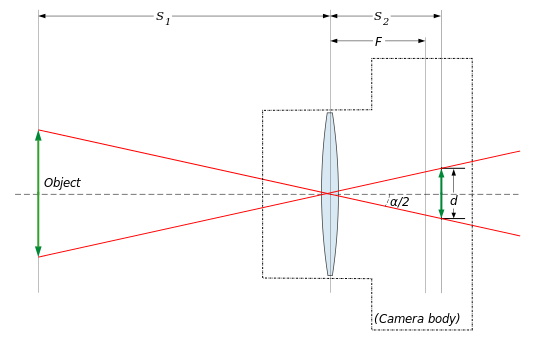
Consider a rectilinear lens in a camera used to photograph an object at a distance S 1 {\displaystyle S_{1}}, and forming an image that just barely fits in the dimension, d {\displaystyle d}, of the frame (the film or image sensor). Treat the lens as if it were a pinhole at distance S 2 {\displaystyle S_{2}} from the image plane (technically, the center of perspective of a rectilinear lens is at the center of its entrance pupil): |
_________________
☮☮☮☮☮☮☮☮☮☮☮☮☮☮☮☮☮☮☮☮☮☮☮☮☮☮☮☮☮☮☮☮ like attracts like! ☮☮☮☮☮☮☮☮☮☮☮☮☮☮☮☮☮☮☮☮☮☮☮☮☮☮☮☮☮☮☮☮
Cameras: Sony ILCE-7RM2, Spotmatics II, F, and ESII, Nikon P4
Lenses:
M42 Asahi Optical Co., Takumar 1:4 f=35mm, 1:2 f=58mm (Sonnar), 1:2.4 f=58mm (Heliar), 1:2.2 f=55mm (Gaussian), 1:2.8 f=105mm (Model I), 1:2.8/105 (Model II), 1:5.6/200, Tele-Takumar 1:5.6/200, 1:6.3/300, Macro-Takumar 1:4/50, Auto-Takumar 1:2.3 f=35, 1:1.8 f=55mm, 1:2.2 f=55mm, Super-TAKUMAR 1:3.5/28 (fat), 1:2/35 (Fat), 1:1.4/50 (8-element), Super-Multi-Coated Fisheye-TAKUMAR 1:4/17, Super-Multi-Coated TAKUMAR 1:4.5/20, 1:3.5/24, 1:3.5/28, 1:2/35, 1:3.5/35, 1:1.8/85, 1:1.9/85 1:2.8/105, 1:3.5/135, 1:2.5/135 (II), 1:4/150, 1:4/200, 1:4/300, 1:4.5/500, Super-Multi-Coated Macro-TAKUMAR 1:4/50, 1:4/100, Super-Multi-Coated Bellows-TAKUMAR 1:4/100, SMC TAKUMAR 1:1.4/50, 1:1.8/55
M42 Carl Zeiss Jena Flektogon 2.4/35
Contax Carl Zeiss Vario-Sonnar T* 28-70mm F3.5-4.5
Pentax K-mount SMC PENTAX-A ZOOM 1:3.5 35~105mm, SMC PENTAX ZOOM 1:4 45~125mm
Nikon Micro-NIKKOR-P-C Auto 1:3.5 f=55mm, NIKKOR-P Auto 105mm f/2.5 Pre-AI (Sonnar), Micro-NIKKOR 105mm 1:4 AI, NIKKOR AI-S 35-135mm f/3,5-4,5
Solinon 1:5.6/18 ASPH.
Tamron SP 17mm f/3.5 (51B), Tamron SP 17mm f/3.5 (151B), SP 500mm f/8 (55BB), SP 70-210mm f/3.5 (19AH)
Vivitar 100mm 1:2.8 MC 1:1 Macro Telephoto (Kiron)
|
|
| Haut de page |
|
|
e6filmuser
Inscrit le: 12 Nov 2010
Messages: 1159
Localisation: Reading UK
|
Posté: Mer Août 28, 2024 12:51 pm Sujet du message: |
|
Posté: Mer Août 28, 2024 12:51 pm Sujet du message: |
|
|
e6filmuser wrote:
Re: the above remarks about not covering a full frame sensor. My images have not been cropped and they were shot at f8 or f11.
| e6filmuser a écrit: |
Here are some images of a slime mould Trichia persimilis from the above setup but A7r, not A7r3:
Taylor Taylor Hobson Cooke Anastigmat 12.5mm at f11, on A7R, 35mm from sensor, FOV 10mm wide. Twin TTL flash.
Crosseye stereo.
This was with the back of the lens ca 35mm from the sensor, the first session being 45mm away:
|
I would add that, on the camera via the adapter shown, the FOV is approximately 10mm wide.
_________________
Dedicated to using manual focus lenses with digital. Equiped for photography from macro to panoramic & from ultra-wide to extreme telephoto. Mostly shooting outdoor macro. Experienced entomological taxonomist. Some knowledge of mushrooms. |
|
| Haut de page |
|
|
e6filmuser
Inscrit le: 12 Nov 2010
Messages: 1159
Localisation: Reading UK
|
Posté: Mer Août 28, 2024 1:29 pm Sujet du message: |
|
Posté: Mer Août 28, 2024 1:29 pm Sujet du message: |
|
|
e6filmuser wrote:
Some years ago, I made a copy of the long list of lens details from "The Macro Lens Collection Database". I am now unable to access that list but my copy show this lens to have FL 12mm when it should be 12.5mm.
_________________
Dedicated to using manual focus lenses with digital. Equiped for photography from macro to panoramic & from ultra-wide to extreme telephoto. Mostly shooting outdoor macro. Experienced entomological taxonomist. Some knowledge of mushrooms. |
|
| Haut de page |
|
|
danfromm
Inscrit le: 04 Sep 2011
Messages: 600
|
Posté: Mer Août 28, 2024 9:19 pm Sujet du message: |
|
Posté: Mer Août 28, 2024 9:19 pm Sujet du message: |
|
|
danfromm wrote:
| stevemark a écrit: |
Developped by Horace William Lee of TTH in 1933. Lens section below.
|
1933? Typo for 1893? |
|
| Haut de page |
|
|
danfromm
Inscrit le: 04 Sep 2011
Messages: 600
|
Posté: Mer Août 28, 2024 9:22 pm Sujet du message: Re: Taylor Hobson Cooke Anastigmat Special Lens 12.5 mm f/2. |
|
Posté: Mer Août 28, 2024 9:22 pm Sujet du message: Re: Taylor Hobson Cooke Anastigmat Special Lens 12.5 mm f/2. |
|
|
danfromm wrote:
| simple.joy a écrit: |
| I'm not sure how old this lens is, but I would guess it's pretty old, judging by its appearance. |
P-H Pont's TTH chronology puts the serial number in the late 1940s. Not that old. |
|
| Haut de page |
|
|
|
|
 Français
 Español
 中文
 Magyar
 Русский
 Deutsch
 日本語



