| Voir le sujet précédent :: Voir le sujet suivant |
| Auteur |
Message |
martinsmith99 

Inscrit le: 31 Août 2008
Messages: 7029
Localisation: S Glos, UK
Expire: 2013-11-18
|
 Posté: Lun Jan 24, 2022 6:10 pm Sujet du message: |
|
Posté: Lun Jan 24, 2022 6:10 pm Sujet du message: |
|
|
martinsmith99 wrote:
Most impressive.
_________________
Casual attendance these days |
|
| Haut de page |
|
 |
kiddo

Inscrit le: 29 Juin 2018
Messages: 1630
|
Posté: Lun Nov 21, 2022 9:01 pm Sujet du message: Re: Minolta MC-X 1.2/58mm and 1.7/85mm repair |
|
Posté: Lun Nov 21, 2022 9:01 pm Sujet du message: Re: Minolta MC-X 1.2/58mm and 1.7/85mm repair |
|
|
kiddo wrote:
| stevemark a écrit: |
Back in 2017, hidden in a lot of old cameras, I bought a MC 1.2/58mm. While from the outside it looked like new, there was quite a bit of fungus inside. Not only was the space between the front group and rear group affected, but there was also fungus inside the sealed front group. Not much later, together with another Minolta collector (and automotive engineer) we tried to dismantle the front group, albeit without success.
Roughly a year later, again hidden in a lot of old stuff, there was an equally nice looking MC 1.7/85mm. Again, there was a problem - its aperture was stuck open. Since I already had a working MC-II 1.7/85mm and MD 1.7/85mm, I didn't bother to open and clean the newly acquired MC-X 1.7/85mm. Both lenses were shelved and forgotten.
Some days ago I decided to give them another try.
The MC-X 1.2/58mm is pretty straightforward when it comes to removing the front and the rear leans groups. However, opening the sealed front group proved to be a bit tricky: There are two small metal rings keeping the front lens in its position. The first ring has two slots for the spanner wrench, and getting it loose was no problem. The second ring - just beneath the first - obviously is sealed and needs rather more force. It seems that Minolta had a special tool for opening it, since there are four slots instead of the usual two. After some trials, and following the suggestions of Richard Haw, also the second ring came free. Cleaning the inner surface of the first lens was relatively easy, and no traces or damage to the coating was visible. The rear surface of the front group and the first surface of the rear gruoup were only slightly affected by fungus, and easy to clean as well. Reassembling the front group and then the entire lens was no problem. Just be very careful when removing the aperture ring - there's a small metal ball behind it (about 1 mm in diameter!), for "clicking" the aperture. It tends to fly away, pushed by a minute spring ...
Now the MC 1.2/58mm was perfectly clean again - and test images did confirm that its optical formula must slightly derive from the earlier MC-II 1.2/58mm: The MC-II has a distinctively yellowish tint, the colors of MC-X on the other hand are in line with other Minolta lenses. The MC-X is sharper wide open, and it has more longitudinal CAs.
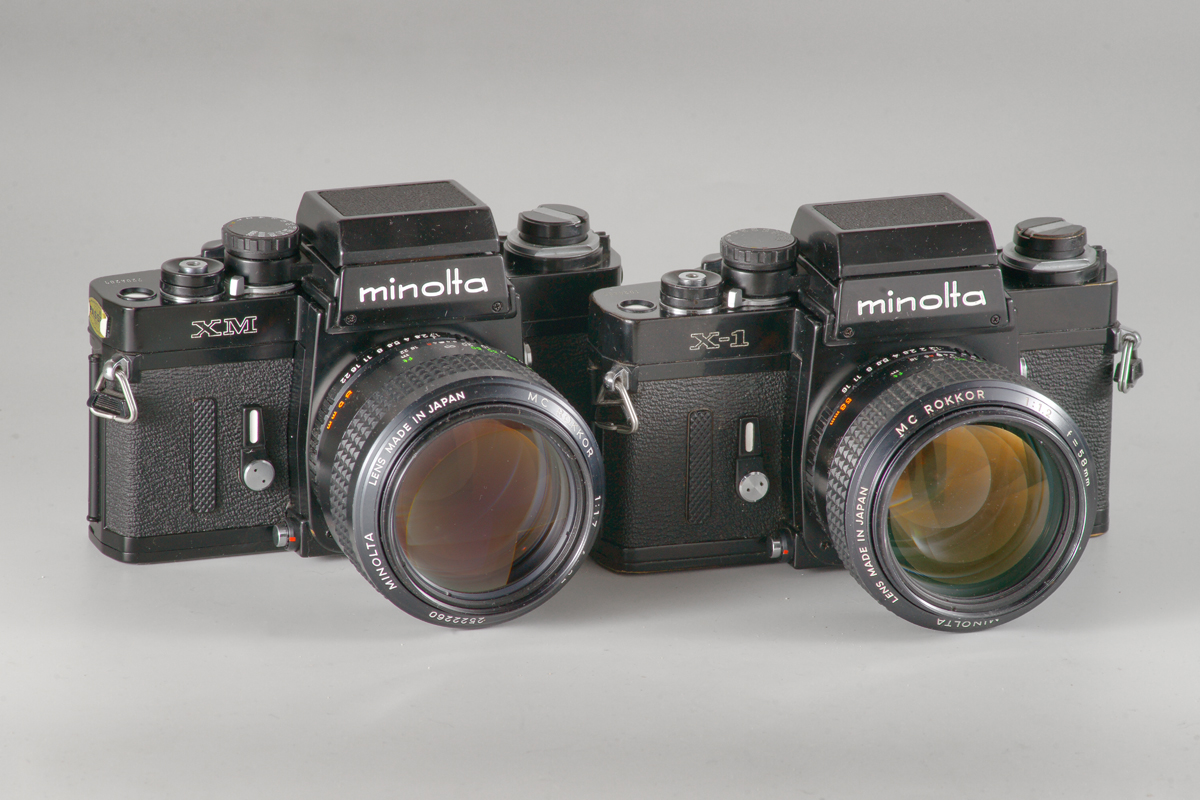
Minolta XM with Minolta MC 1.7/85mm (left) and Minolta X-1 with Minolta MC 1.2/58mm (right), after cleaning
Now having successfully completed the removing of fungus from the 1.2/58mm I thought that cleaning the aperture of the 1.7/85mm would be easy and quickly done. I was wrong, though. More information on that one tomorrow 
S |
Hi Steve, I've just git a first version of this lens, with iris not opening, even though aperture ring is working, it also got plenty of dust ,bit of haze and some small spots of fungus. To acces iris , is it necessary to open the whole lens including helicoidal etc? Or would be enough to remove front and rear groups ? I understand this first version has got very sensitive coatings, how could I remove fungus without damaging the coatings, as rinsing the elements I'm not sure would totally remove small spots of fungus (I've never tried it) |
|
| Haut de page |
|
|
stevemark
Inscrit le: 29 Avr 2011
Messages: 5511
Localisation: Switzerland
|
Posté: Lun Nov 21, 2022 10:39 pm Sujet du message: Re: Minolta MC-X 1.2/58mm and 1.7/85mm repair |
|
Posté: Lun Nov 21, 2022 10:39 pm Sujet du message: Re: Minolta MC-X 1.2/58mm and 1.7/85mm repair |
|
|
stevemark wrote:
| kiddo a écrit: |
Hi Steve, I've just git a first version of this lens, with iris not opening, even though aperture ring is working, it also got plenty of dust ,bit of haze and some small spots of fungus. To acces iris , is it necessary to open the whole lens including helicoidal etc? Or would be enough to remove front and rear groups ? |
I don't know whether the mechanical construction of the MC-II and the MC-X 1.7/85mm is identical. If you have "freed" the aperture block from the helicoids, you may try to clean it by rinsing with plenty of a solvent such as acetone. In my case i didn't work, however, since the aperture blades were partly covered with a tar-like substance. I had to dismantle everything.
| kiddo a écrit: |
| I understand this first version has got very sensitive coatings, how could I remove fungus without damaging the coatings, as rinsing the elements I'm not sure would totally remove small spots of fungus (I've never tried it) |
I would try a very soft paper and a few dops of detergent in about 100ml of water. That always worked for me, without damaging the coatings. There was one single exception, however - a wartime coated Carl Zeiss Jena Sonnar 1.5/5cm which had extremely sensitive inner coatings (outer coatings were no problem).
You might also try an alcohol such as propanol or iso-propanol.
S
_________________
www.artaphot.ch |
|
| Haut de page |
|
|
kiddo
Inscrit le: 29 Juin 2018
Messages: 1630
|
Posté: Mar Nov 22, 2022 1:12 am Sujet du message: Re: Minolta MC-X 1.2/58mm and 1.7/85mm repair |
|
Posté: Mar Nov 22, 2022 1:12 am Sujet du message: Re: Minolta MC-X 1.2/58mm and 1.7/85mm repair |
|
|
kiddo wrote:
| stevemark a écrit: |
| kiddo a écrit: |
Hi Steve, I've just git a first version of this lens, with iris not opening, even though aperture ring is working, it also got plenty of dust ,bit of haze and some small spots of fungus. To acces iris , is it necessary to open the whole lens including helicoidal etc? Or would be enough to remove front and rear groups ? |
I don't know whether the mechanical construction of the MC-II and the MC-X 1.7/85mm is identical. If you have "freed" the aperture block from the helicoids, you may try to clean it by rinsing with plenty of a solvent such as acetone. In my case i didn't work, however, since the aperture blades were partly covered with a tar-like substance. I had to dismantle everything.
| kiddo a écrit: |
| I understand this first version has got very sensitive coatings, how could I remove fungus without damaging the coatings, as rinsing the elements I'm not sure would totally remove small spots of fungus (I've never tried it) |
I would try a very soft paper and a few dops of detergent in about 100ml of water. That always worked for me, without damaging the coatings. There was one single exception, however - a wartime coated Carl Zeiss Jena Sonnar 1.5/5cm which had extremely sensitive inner coatings (outer coatings were no problem).
You might also try an alcohol such as propanol or iso-propanol.
S |
Sorry, my bad, i was referring to the 58mm 1.2, as I've got the first version all metal hills and valleys. It's got stuck iris , si I'm not sure if a whole removing helical/aperture ring would be necessary |
|
| Haut de page |
|
|
caspert79

Inscrit le: 31 Oct 2010
Messages: 3916
Localisation: The Netherlands
|
Posté: Mar Nov 22, 2022 5:20 am Sujet du message: |
|
Posté: Mar Nov 22, 2022 5:20 am Sujet du message: |
|
|
caspert79 wrote:
Luckily I know a very experienced camera repair man here in The Netherlands that does these kinds of repairs for me for a reasonable price. I've did a few aperture repairs in the past, some with succes, but I killed a few lenses as well 😊. Expensive lenses I usually hand over to the expert. |
|
| Haut de page |
|
|
RokkorDoctor

Inscrit le: 27 Nov 2021
Messages: 1562
Localisation: Kent, UK
Expire: 2025-05-01
|
Posté: Mar Nov 22, 2022 10:39 am Sujet du message: Re: Minolta MC-X 1.2/58mm and 1.7/85mm repair |
|
Posté: Mar Nov 22, 2022 10:39 am Sujet du message: Re: Minolta MC-X 1.2/58mm and 1.7/85mm repair |
|
|
RokkorDoctor wrote:
| kiddo a écrit: |
| stevemark a écrit: |
| kiddo a écrit: |
Hi Steve, I've just git a first version of this lens, with iris not opening, even though aperture ring is working, it also got plenty of dust ,bit of haze and some small spots of fungus. To acces iris , is it necessary to open the whole lens including helicoidal etc? Or would be enough to remove front and rear groups ? |
I don't know whether the mechanical construction of the MC-II and the MC-X 1.7/85mm is identical. If you have "freed" the aperture block from the helicoids, you may try to clean it by rinsing with plenty of a solvent such as acetone. In my case i didn't work, however, since the aperture blades were partly covered with a tar-like substance. I had to dismantle everything.
| kiddo a écrit: |
| I understand this first version has got very sensitive coatings, how could I remove fungus without damaging the coatings, as rinsing the elements I'm not sure would totally remove small spots of fungus (I've never tried it) |
I would try a very soft paper and a few dops of detergent in about 100ml of water. That always worked for me, without damaging the coatings. There was one single exception, however - a wartime coated Carl Zeiss Jena Sonnar 1.5/5cm which had extremely sensitive inner coatings (outer coatings were no problem).
You might also try an alcohol such as propanol or iso-propanol.
S |
Sorry, my bad, i was referring to the 58mm 1.2, as I've got the first version all metal hills and valleys. It's got stuck iris , si I'm not sure if a whole removing helical/aperture ring would be necessary |
The 58/1.2 is VERY similar in construction to the 85/1.7, so you can pretty much follow most of the instructions for the 85/1.7 as documented by Stephan (stevemark).
The one big difference is that the 58/1.2 has a slightly more elaborate lens mount construction which contains a ball-race. This lens has 8 screws on the back, alternating long & short ones. The long ones hold the entire mount assembly onto the lens. The short ones hold the ball-race assembly together. Remove two adjacent screws to work out which of the alternating long & short screws are the long ones and which are the short ones. Then put the short one back and proceed to only remove the LONG screws to take off the mount assembly. If you remove the short ones you will be searching the floor for a few tiny balls and spacers. Don't ask how I know this... 
The entire aperture assembly separates from the helicoid very much like the 85/1.7 as demonstrated by Stephan.
Good luck.
_________________
Mark
SONY A7S, A7RII + dust-sealed modded Novoflex/Fotodiox/Rayqual MD-NEX adapters
Minolta SR-1, SRT-101/303, XD7/XD11, XGM, X700
Bronica SQAi
Ricoh GX100
Minolta majority of all Rokkor SR/AR/MC/MD models made
Sigma 14mm/3.5 for SR mount
Tamron SP 60B 300mm/2.8 (Adaptall)
Samyang T-S 24mm/3.5 (Nikon mount, DIY converted to SR mount)
Schneider-Kreuznach PC-Super-Angulon 28mm/2.8 (SR mount)
Bronica PS 35/40/50/65/80/110/135/150/180/200/250mm |
|
| Haut de page |
|
|
left eye
Inscrit le: 29 Avr 2022
Messages: 5
|
Posté: Ven Août 23, 2024 11:14 am Sujet du message: Re: Minolta MC-X 1.2/58mm and 1.7/85mm repair |
|
Posté: Ven Août 23, 2024 11:14 am Sujet du message: Re: Minolta MC-X 1.2/58mm and 1.7/85mm repair |
|
|
left eye wrote:
I have a PF 85mm f1.7, but infinity focuses at 7m on the distance scale (at least it's not on the other side of infinity!).
This is ok though it bugs me the focus scale bears no relation to actual distances, and I presume I'm loosing some close focus distance.
Is there a path to a more simple disassembly that would allow me to more easily correct this than the complete disassembly you detailed?
I presume it's the aluminium helicoid that's one thread out (though probably guess work involved to correct), and the brass helicoid can be left in place? ...so how to get to the aluminium helicoid without too much trouble.
I've taken Helios's apart before, but I'm no expert at lens disassembly. |
|
| Haut de page |
|
|
kiddo
Inscrit le: 29 Juin 2018
Messages: 1630
|
Posté: Ven Août 23, 2024 11:26 am Sujet du message: Re: Minolta MC-X 1.2/58mm and 1.7/85mm repair |
|
Posté: Ven Août 23, 2024 11:26 am Sujet du message: Re: Minolta MC-X 1.2/58mm and 1.7/85mm repair |
|
|
kiddo wrote:
| left eye a écrit: |
I have a PF 85mm f1.7, but infinity focuses at 7m on the distance scale (at least it's not on the other side of infinity!).
This is ok though it bugs me the focus scale bears no relation to actual distances, and I presume I'm loosing some close focus distance.
Is there a path to a more simple disassembly that would allow me to more easily correct this than the complete disassembly you detailed?
I presume it's the aluminium helicoid that's one thread out (though probably guess work involved to correct), and the brass helicoid can be left in place? ...so how to get to the aluminium helicoid without too much trouble.
I've taken Helios's apart before, but I'm no expert at lens disassembly. |
If you suspect the lens wasn't opened before, it might only need the infinity adjusted (some adapters are very bad regarding tolerance) , in most of the cases , i was able to do that by adjusting the front group to infinity (there should be a retainer ring/screw that holds it in place) so it might not need to open the helicoid. Anyway, what adapter are you using? Did you try it with other Minolta lens to make sure the adapter is ok? |
|
| Haut de page |
|
|
left eye
Inscrit le: 29 Avr 2022
Messages: 5
|
Posté: Ven Août 23, 2024 12:14 pm Sujet du message: Re: Minolta MC-X 1.2/58mm and 1.7/85mm repair |
|
Posté: Ven Août 23, 2024 12:14 pm Sujet du message: Re: Minolta MC-X 1.2/58mm and 1.7/85mm repair |
|
|
left eye wrote:
| kiddo a écrit: |
If you suspect the lens wasn't opened before, it might only need the infinity adjusted (some adapters are very bad regarding tolerance) , in most of the cases , i was able to do that by adjusting the front group to infinity (there should be a retainer ring/screw that holds it in place) so it might not need to open the helicoid. Anyway, what adapter are you using? Did you try it with other Minolta lens to make sure the adapter is ok? |
Thanks for the quick reply, on which is quite an old thread by now - but very valuable!
The 7m on the focus scale has a vertical silver scratch though it, not noticed it before as wasn't trying to focus on infinity, but now it makes sense, 7m is the new infinity.
When I got the lens, which looks good BTW, it had been de-clicked, oh yes!! I thought, that means someone lost the indent ball. I replaced that, so the click stops now work. Anyway someone definitely has been inside it before.
Adjusting the front group to infinity sounds like a good start (not requiring a total strip down), but how?
/
Adapter is a Kipon, also tested with a K&F concept, and with other Rokors, it's definitely an issue with the 85mm. |
|
| Haut de page |
|
|
BrianSVP

Inscrit le: 09 Juin 2023
Messages: 664
Localisation: Philadelphia
|
Posté: Ven Août 23, 2024 2:14 pm Sujet du message: |
|
Posté: Ven Août 23, 2024 2:14 pm Sujet du message: |
|
|
BrianSVP wrote:
Just want to add here that for the earliest knurl-gripped versions of the 58, the name ring doesn't unscrew like on the later versions, and it's a substantially more involved disassembly to get to the infinity adjustment screws.
It's been quite some time since I operated on an early version of the 85, so I can't recall off the top of my head whether it's true of that lens as well, so YMMV. |
|
| Haut de page |
|
|
stevemark
Inscrit le: 29 Avr 2011
Messages: 5511
Localisation: Switzerland
|
Posté: Ven Août 23, 2024 2:16 pm Sujet du message: Re: Minolta MC-X 1.2/58mm and 1.7/85mm repair |
|
Posté: Ven Août 23, 2024 2:16 pm Sujet du message: Re: Minolta MC-X 1.2/58mm and 1.7/85mm repair |
|
|
stevemark wrote:
| left eye a écrit: |
I have a PF 85mm f1.7, but infinity focuses at 7m on the distance scale (at least it's not on the other side of infinity!).
...
I presume it's the aluminium helicoid that's one thread out (though probably guess work involved to correct) |
No.
Adjusting infinity on the MD 1.7/85mm is EXTREMELY simple:
1) Set the lens to REAL infinity (focus it using live view on a "infinity" subject)
2) Remove the name ring by turning it counter clock wise (as in the very first image of this thread)
3) Looking into the dark gap between (outer) focusing ring and (inner) lens body you will notice four small screws.
4) Unscrew them slightly (no need to removem them completely!)
5) Set the outer focusing ring to infinity WITHOUT messing with the (inner) lens body
6) Tighten the four screws
7) Check the infinity using live view (if it's still slightly off-scale - start at 1) again)
Done!
S
_________________
www.artaphot.ch |
|
| Haut de page |
|
|
stevemark
Inscrit le: 29 Avr 2011
Messages: 5511
Localisation: Switzerland
|
Posté: Ven Août 23, 2024 2:16 pm Sujet du message: Re: Minolta MC-X 1.2/58mm and 1.7/85mm repair |
|
Posté: Ven Août 23, 2024 2:16 pm Sujet du message: Re: Minolta MC-X 1.2/58mm and 1.7/85mm repair |
|
|
stevemark wrote:
| stevemark a écrit: |
| left eye a écrit: |
I have a PF 85mm f1.7, but infinity focuses at 7m on the distance scale (at least it's not on the other side of infinity!).
...
I presume it's the aluminium helicoid that's one thread out (though probably guess work involved to correct) |
No.
Adjusting infinity on the MC-X/MD-I 1.7/85mm is EXTREMELY simple:
1) Set the lens to REAL infinity (focus it using live view on a "infinity" subject)
2) Remove the name ring by turning it counter clock wise (as in the very first image of this thread)
3) Looking into the dark gap between (outer) focusing ring and (inner) lens body you will notice four small screws.
4) Unscrew them slightly (no need to removem them completely!)
5) Set the outer focusing ring to infinity WITHOUT messing with the (inner) lens body
6) Tighten the four screws
7) Check the infinity using live view (if it's still slightly off-scale - start at 1) again)
Done!
S |
_________________
www.artaphot.ch |
|
| Haut de page |
|
|
BrianSVP
Inscrit le: 09 Juin 2023
Messages: 664
Localisation: Philadelphia
|
Posté: Ven Août 23, 2024 2:18 pm Sujet du message: Re: Minolta MC-X 1.2/58mm and 1.7/85mm repair |
|
Posté: Ven Août 23, 2024 2:18 pm Sujet du message: Re: Minolta MC-X 1.2/58mm and 1.7/85mm repair |
|
|
BrianSVP wrote:
| left eye a écrit: |
When I got the lens, which looks good BTW, it had been de-clicked, oh yes!! I thought, that means someone lost the indent ball. I replaced that, so the click stops now work. Anyway someone definitely has been inside it before.
|
Interesting. The way the mount is designed on this lens, if the ball detent is removed, there is spring pressure on the mechanism that will cause the ring to move position unless you constantly keep pressure on it. If yours didn't behave like this, there might have been more extensive mods done.
As you doubtlessly discovered while reclicking, these lenses also use an extremely tiny detent, about the smallest that any lens uses, that tends to go flying right off when the lens is opened, so it could be less-than-intentional declicking that occurred when whoever owned the lens before went poking around in the rear to see if they oculd figure out the infinity issue that way. |
|
| Haut de page |
|
|
left eye
Inscrit le: 29 Avr 2022
Messages: 5
|
Posté: Ven Août 23, 2024 2:42 pm Sujet du message: Re: Minolta MC-X 1.2/58mm and 1.7/85mm repair |
|
Posté: Ven Août 23, 2024 2:42 pm Sujet du message: Re: Minolta MC-X 1.2/58mm and 1.7/85mm repair |
|
|
left eye wrote:
| stevemark a écrit: |
| stevemark a écrit: |
| left eye a écrit: |
I have a PF 85mm f1.7, but infinity focuses at 7m on the distance scale (at least it's not on the other side of infinity!).
...
I presume it's the aluminium helicoid that's one thread out (though probably guess work involved to correct) |
No.
Adjusting infinity on the MC-X/MD-I 1.7/85mm is EXTREMELY simple:
1) Set the lens to REAL infinity (focus it using live view on a "infinity" subject)
2) Remove the name ring by turning it counter clock wise (as in the very first image of this thread)
3) Looking into the dark gap between (outer) focusing ring and (inner) lens body you will notice four small screws.
4) Unscrew them slightly (no need to removem them completely!)
5) Set the outer focusing ring to infinity WITHOUT messing with the (inner) lens body
6) Tighten the four screws
7) Check the infinity using live view (if it's still slightly off-scale - start at 1) again)
Done!
S |
|
This is excellent news, so just to get the front ring off will be the main task.
My lens is the MC PF, so should also follow your description?
#1
 |
|
| Haut de page |
|
|
stevemark
Inscrit le: 29 Avr 2011
Messages: 5511
Localisation: Switzerland
|
Posté: Ven Août 23, 2024 2:45 pm Sujet du message: Re: Minolta MC-X 1.2/58mm and 1.7/85mm repair |
|
Posté: Ven Août 23, 2024 2:45 pm Sujet du message: Re: Minolta MC-X 1.2/58mm and 1.7/85mm repair |
|
|
stevemark wrote:
| left eye a écrit: |
My lens is the MC PF, so should also follow your description?
|
Probably yes.
My own MC-II curently is stored away, so I can't check it at the moment. Turn the lens to MFD (minimal focus distance) which exposes the front ring, turn the front ring counter clock wise and remove it, and re-focus your lens to REAL infinity (around 7m in your case), then start adjusting as I wrote above.
S
_________________
www.artaphot.ch |
|
| Haut de page |
|
|
left eye
Inscrit le: 29 Avr 2022
Messages: 5
|
Posté: Ven Août 23, 2024 2:46 pm Sujet du message: Re: Minolta MC-X 1.2/58mm and 1.7/85mm repair |
|
Posté: Ven Août 23, 2024 2:46 pm Sujet du message: Re: Minolta MC-X 1.2/58mm and 1.7/85mm repair |
|
|
left eye wrote:
| BrianSVP a écrit: |
| left eye a écrit: |
When I got the lens, which looks good BTW, it had been de-clicked, oh yes!! I thought, that means someone lost the indent ball. I replaced that, so the click stops now work. Anyway someone definitely has been inside it before.
|
Interesting. The way the mount is designed on this lens, if the ball detent is removed, there is spring pressure on the mechanism that will cause the ring to move position unless you constantly keep pressure on it. If yours didn't behave like this, there might have been more extensive mods done.
As you doubtlessly discovered while reclicking, these lenses also use an extremely tiny detent, about the smallest that any lens uses, that tends to go flying right off when the lens is opened, so it could be less-than-intentional declicking that occurred when whoever owned the lens before went poking around in the rear to see if they oculd figure out the infinity issue that way. |
Yes you are totally correct! The previous owner had 'installed' a very fine black rubber band/ring in the gap behind the aperture ring (on the outside of the barrel) - which added enough friction to stop the spring action of the aperture closing it slightly. Anyway I've got that 'rubber band' off (-nearly invisible 1/2mm thick), and I put the ball detent in, the aperture working well - and as originally intended! |
|
| Haut de page |
|
|
mouks
Inscrit le: 22 Juin 2024
Messages: 45
Localisation: Switzerland
|
Posté: Ven Août 23, 2024 9:02 pm Sujet du message: |
|
Posté: Ven Août 23, 2024 9:02 pm Sujet du message: |
|
|
mouks wrote:
--
Dernière modification par mouks le Jeu Sep 18, 2025 1:25 pm ; modifié 1 fois au total |
|
| Haut de page |
|
|
left eye
Inscrit le: 29 Avr 2022
Messages: 5
|
Posté: Dim Août 25, 2024 7:54 am Sujet du message: Re: Minolta MC-X 1.2/58mm and 1.7/85mm repair |
|
Posté: Dim Août 25, 2024 7:54 am Sujet du message: Re: Minolta MC-X 1.2/58mm and 1.7/85mm repair |
|
|
left eye wrote:
| stevemark a écrit: |
| stevemark a écrit: |
| left eye a écrit: |
I have a PF 85mm f1.7, but infinity focuses at 7m on the distance scale (at least it's not on the other side of infinity!).
...
I presume it's the aluminium helicoid that's one thread out (though probably guess work involved to correct) |
No.
Adjusting infinity on the MC-X/MD-I 1.7/85mm is EXTREMELY simple:
1) Set the lens to REAL infinity (focus it using live view on a "infinity" subject)
2) Remove the name ring by turning it counter clock wise (as in the very first image of this thread)
3) Looking into the dark gap between (outer) focusing ring and (inner) lens body you will notice four small screws.
4) Unscrew them slightly (no need to removem them completely!)
5) Set the outer focusing ring to infinity WITHOUT messing with the (inner) lens body
6) Tighten the four screws
7) Check the infinity using live view (if it's still slightly off-scale - start at 1) again)
Done!
S |
|
It worked! all is now at one in the universe.
The furthest reference around here I could find was a mile away, so I set infinity a hair beyond that.
The moon was in the morning sky, so I thought that an ideal infinity ref point. The strange thing was, it focused closer than the tree which was 1 mile away!
I'd have assumed the moon would be perfect for settling infinity, but maybe as it's beyond our atmosphere, the atmosphere is acting to focus it closer - could this be? - I know our atmosphere can act as a lens to magnify the moon - to a greater extent nearer the horizon where its light passes through more atmosphere, or from a greater angle of refraction - but for it to be closer than 1 mile away??
Anyway, the 85mm is now fully back in order, with it's ball detent click-stop on the aperture, and infinity where it should be, MFD is closer, and the moon is less than 1 mile away, all good.
Many thanks Steve for getting back to me with a simple solution to this, saved the day. |
|
| Haut de page |
|
|
stevemark
Inscrit le: 29 Avr 2011
Messages: 5511
Localisation: Switzerland
|
Posté: Dim Août 25, 2024 9:11 am Sujet du message: Re: Minolta MC-X 1.2/58mm and 1.7/85mm repair |
|
Posté: Dim Août 25, 2024 9:11 am Sujet du message: Re: Minolta MC-X 1.2/58mm and 1.7/85mm repair |
|
|
stevemark wrote:
| left eye a écrit: |
It worked! all is now at one in the universe. |
Perfect! Such days are rare these days
| left eye a écrit: |
The furthest reference around here I could find was a mile away, so I set infinity a hair beyond that.
The moon was in the morning sky, so I thought that an ideal infinity ref point. The strange thing was, it focused closer than the tree which was 1 mile away! |
As you can see from the image below (from wikipedia), orange-yellow light [moon] does have a different refraction compare to green light (tree). This is valid for any glass with a "normal" (=non-anomalous) dispersion. It makes perfect sense: If you want to focus on the moon, your lens must be furtther away fron the sensor than if you want to focus on a green tree.

| left eye a écrit: |
I know our atmosphere can act as a lens to magnify the moon - to a greater extent nearer the horizon where its light passes through more atmosphere, or from a greater angle of refraction??
|
No, out atmosphere doesn't magnify the moon. The phenomenon (full moon looks huge just above the horizon) is a simple optical illusion, even though NASA "public engagement specialist" Preston Dyches (wrongly) claims the reason "isn't fully understood". Just look at the image below - both central circles do have the same diameter, but - depending on what surrounds them - they seem to have a very different diameter. If the moon is surrounded by "small" objects (e. g. small trees in a distance at the horizon), it will look huge - if the moon is surrounded by nearby (=large) trees, it will look small ...

_________________
www.artaphot.ch |
|
| Haut de page |
|
|
stevemark
Inscrit le: 29 Avr 2011
Messages: 5511
Localisation: Switzerland
|
Posté: Jeu Déc 26, 2024 4:01 pm Sujet du message: |
|
Posté: Jeu Déc 26, 2024 4:01 pm Sujet du message: |
|
|
stevemark wrote:
| RokkorDoctor a écrit: |
In some Rokkor lenses (notably the MC W. ROKKOR 24mm f/2.8 ) Minolta used an anti-diffusion compound ("Emralon 325 antidiffusion compound", as per the service manual for the 24mm f/2.8 ). This is applied on the inner barrel between the helicoid and the aperture assembly, clearly intended to prevent oil migration into the aperture assembly.
|
Seems to be a PTFE coated resin ("Teflon"), according to the NASA "Lubrication Handbook for Space Industry".
S
_________________
www.artaphot.ch |
|
| Haut de page |
|
|
|
|
 Français
 Español
 中文
 Magyar
 Русский
 Deutsch
 日本語